
Choose an Easter Tablecloth: Size, Fabric & Drop
Louis MikolajczakShare
How to Choose the Right Tablecloth for a Perfect Easter Table: Materials, Sizes, and Drop Length
Choosing an Easter tablecloth isn't just "putting fabric on a table." It instantly sets the style: chic table, rustic table, pastel table, natural table… and most importantly, a pleasant dining experience. The real problem is that we often make mistakes on three points: the material (too delicate or too stiff), the size (too short or trailing), and the drop length (not harmonious, not practical). In this guide, you will learn how to choose the perfect tablecloth according to your table (round, rectangular, oval), the number of guests, the Easter ambiance you desire, and your level of "stain tolerance." You will also find a ready-to-use size chart, tips for a perfect drop, and a simple post-meal cleaning routine (chocolate, grease, wine…).
If you first want to compare materials for real-world use, our guide which tablecloth material to choose for everyday use provides a good starting point. And to browse available formats and styles, you can also check out our tablecloth collection.
- Why the Tablecloth Transforms Your Easter Table
- Quick Choice: The Ideal Tablecloth for Your Style and Meal
- Materials: Linen, Cotton, Coated… Which for Easter?
- Size Guide: Choosing the Right Dimension Without Error
- Perfect Drop: How Many Inches to Allow?
- Special Tables: Round, Oval, Extensions
- Setting the Table: Creating a Harmonious Easter Table (Without Overloading)
- Post-Easter Care: Stains, Washing, Ironing
- To Avoid: Mistakes That Ruin a Beautiful Tablecloth
- Frequently Asked Questions
- Quick Memo
Why the Tablecloth Transforms Your Easter Table
A tablecloth does two things at once: it dresses and it structures. It provides a visual base (the dominant color), softens the light, and makes the table feel more "finished." Even with simple dinnerware, a quality tablecloth gives the impression of a thoughtfully prepared table.
And for Easter, this is even more true: we often have longer meals, with chocolate, sauces, shared dishes, children… So the tablecloth must be pretty, yes, but also adapted to real use: it must stay in place, not interfere with chairs, and not make you want to cry at the first stain.
Quick Choice: The Ideal Tablecloth for Your Style and Meal
If you want to get straight to the point, here are some simple guidelines. Then, we'll detail everything (materials, sizes, drop length, care).
You want a "natural & chic" table (very Easter)
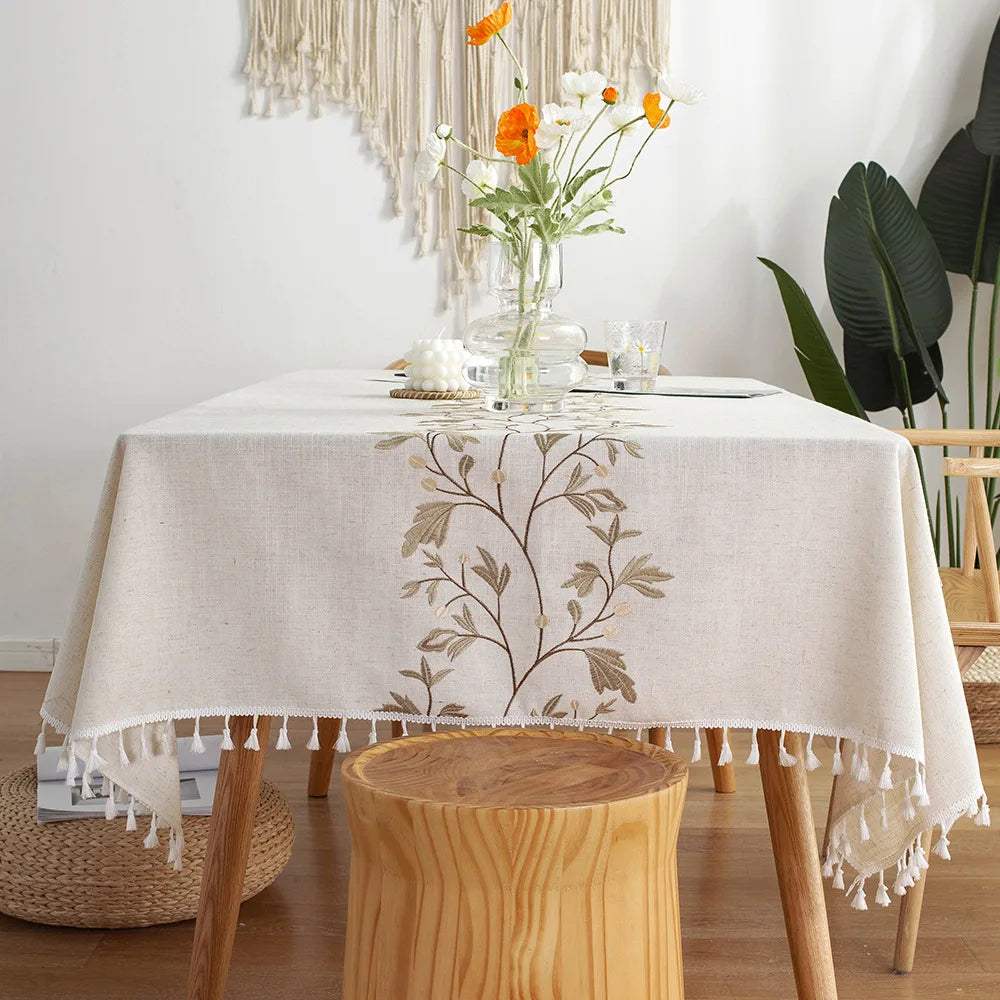
Linen or thick cotton, in ecru, off-white, beige, sage green. Medium drop (10–12 inches). Add 2–3 elements: candles, flowers, and you're done.
You want a "practical" table (children, chocolate, lively meal)
Coated tablecloth or stain-treated. Visually, it can be very attractive if you choose a fabric effect (not shiny). Short drop (8–10 inches) to prevent it from trailing.
You want a "very elegant" table (quieter meal)
Washed linen or high-end cotton, with a longer drop (12–14 inches) and a beautiful harmony of tones. Avoid overly busy patterns: class is often conveyed through the material.
Materials: Linen, Cotton, Coated… Which for Easter?
The right choice is not "the best material in the world." It's the material that matches your Easter meal and your daily life. Here are the most useful options, with their advantages and pitfalls.
Linen: The most beautiful "festive table" look
Linen immediately gives a chic and natural style. It "drapes" well, catches the light, and effortlessly creates a well-kept home ambiance. It's a highly favored choice for a successful Easter table, especially if you like soft tones: ecru, off-white, beige, sage green.
- Strengths: High-end, natural, timeless appearance.
- To know: It wrinkles (which is also part of its charm). It requires a bit more attention to grease stains.
Cotton: Simple, effective, easy to live with
Cotton is often the best compromise: pleasant, easy to wash, and less "stressful" than linen. It's available in light cotton (more fluid) or thick cotton (more "table-holding").
- Strengths: Easy to care for, wide choice of colors, good budget.
- To know: Too thin cotton can "mark" creases and shift more easily.
Coated tablecloth: The queen of the family table
For Easter, with children or a very indulgent meal, a coated tablecloth can save you. It cleans with a wipe of a sponge and prevents panic over melted chocolate. The secret is to choose a coating that retains a fabric effect, not a shiny plastic finish.
- Strengths: Ultra practical, stain-resistant for everyday use, ideal for lively meals.
- To know: Some coated tablecloths don't tolerate ironing and high heat as well.
Size Guide: Choosing the Right Dimension Without Error
The method is always the same: measure the table, then add the drop. It's that simple.
To avoid recalculating for each tabletop, you can also consult our guide what size tablecloth for a rectangular table. If your table measures exactly 180 cm, the guide 180 rectangular table provides adapted drops; for a round table of 150 cm, find the tablecloth diameter calculation.
The quick formula
Tablecloth length = table length + (2 × drop)
Tablecloth width = table width + (2 × drop)
Example: table 160 × 90 cm, 30 cm drop → ideal tablecloth = (160 + 60) × (90 + 60) = 220 × 150 cm.
| Table type | Table size | Recommended drop | Recommended tablecloth size | Practical tip |
|---|---|---|---|---|
| Rectangular | 120 × 80 cm | 25–30 cm | 170/180 × 130/140 cm | Perfect for 4 people |
| Rectangular | 140 × 90 cm | 25–30 cm | 200 × 150 cm | Ideal if you want a nice drape |
| Rectangular | 160 × 90 cm | 25–30 cm | 220 × 150 cm | Very common size |
| Rectangular | 180 × 100 cm | 25–30 cm | 240 × 160 cm | Comfortable for 6–8 people |
| Rectangular | 200 × 100 cm | 25–30 cm | 260 × 160 cm | Great for large gatherings |
| Round | Ø 100 cm | 25–30 cm | Ø 160 cm | Harmonious drop without hindering |
| Round | Ø 120 cm | 25–30 cm | Ø 180 cm | Very beautiful "festive table" effect |
| Round | Ø 140 cm | 25–30 cm | Ø 200 cm | For large table, chic look |
If you're between two sizes, often choose the larger size to maintain a regular drop… unless you have children who easily pull on the tablecloth (in which case, a shorter drop).
Perfect Drop: How Many Inches to Allow?
The drop is what transforms a "decent" tablecloth into a "stunning" one. Too short: it looks sad. Too long: it gets in the way, gets dirty, catches on knees. Here are the simple guidelines.
The 3 drops that work (depending on use)
- 8–10 inches: perfect if you want a practical table (children, lively meal, chairs close together).
- 10–12 inches: the "ideal" drop for most Easter tables.
- 12–14 inches: a more dressed-up, "festive" look, to prefer if space is comfortable.
The simple test before Easter
Sit at the table and check two things:
1) the tablecloth doesn't touch your knees when you move
2) the tablecloth doesn't get caught in armrests or chair legs
If it catches, shorten the drop or change the size: comfort should remain a priority.
Special Tables: Round, Oval, Extensions
Round table: The tablecloth should drape "evenly"
On a round table, the drop is immediately noticeable. A tablecloth that's too small gives a "doily" effect, while one that's too large creates a "curtain" effect. The guidelines in the table above work very well. If you want a truly chic table, aim for a 12-inch drop (if it doesn't get in the way).
Oval table: Think "maximum dimensions"
Measure the longest length and the widest width, then apply the formula. An oval table works very well with a rectangular tablecloth, as long as the drop remains balanced.
Table with extension: Choose your strategy
Two options exist, and both are good:
- Option 1: Tablecloth sized for the table when open (on Easter day, it's peace of mind).
- Option 2: "Standard" tablecloth + table runner or placemats in the center to hide the joint.
Setting the Table: Creating a Harmonious Easter Table (Without Overloading)
A successful Easter table is rarely a cluttered table. It's a table that breathes. The tablecloth should be the base, and the decor should simply complement it. If you want to structure the center without adding too many objects, our guide which table runner to choose for Easter naturally complements the tablecloth choice.
Color harmonies that always work
- Sage green + white + wood: very fresh, very "spring," easy to achieve.
- Beige + off-white + white flowers: chic, luminous, timeless.
- Soft pastel (powder pink, pale yellow, tender green): perfect for a family atmosphere.
The simple rule: maximum 3 materials
Easy example: linen (tablecloth) + ceramic (plates) + glass (glasses). And you add a small natural touch: wood, flowers, or candles. Beyond that, it quickly becomes "too much."
Post-Easter Care: Stains, Washing, Ironing
Easter is the perfect combo for stains: chocolate, grease, wine, candle wax, sauce… The important thing isn't to have a tablecloth that's "impossible to stain." The important thing is to know what to do quickly.
Reflex 1: Act without rubbing
Dab, absorb, then treat. Rubbing spreads the stain and damages the fibers.
Reflex 2: Treat before washing (especially grease)
Grease loves to set during washing if nothing is done beforehand. A drop of dish soap (very little) on the stain, a little warm water, dab, then wash.
Reflex 3: Chocolate
Let it cool, remove the excess, then warm water + mild soap. Avoid very hot water at first: it can "cook" the chocolate into the fiber.
| Stain | Immediate action | Gentle cleaning | To avoid | Tip |
|---|---|---|---|---|
| Chocolate | Remove excess, dab | Warm water + mild soap | Direct boiling water | Treat before washing |
| Grease / sauce | Absorb (paper), do not rub | A drop of diluted dish soap | Washing without pre-treatment | Grease sets if you wait |
| Wine | Dab immediately | Cold water then mild soap | Rubbing hard | The longer you wait, the more it sets |
| Candle wax | Let harden | Gently scrape + absorbent paper + warm iron | Scraping when liquid | Paper "absorbs" the wax |
If your tablecloth is linen: accept that it will live a little. A beautiful festive tablecloth is often one with a story… as long as it remains clean and pleasant.
To Avoid: Mistakes That Ruin a Beautiful Tablecloth
- A tablecloth that's too long: it catches on knees, gets dirty quickly, and makes the table less comfortable.
- A tablecloth that's too small: "doily" effect, especially on a large table.
- A shiny coating: often gives a plastic and less warm appearance.
- Overly busy patterns + too much decor: the table becomes confusing.
- Forgetting maintenance: a beautiful tablecloth lasts a long time if stains are treated correctly and promptly.
Frequently Asked Questions
What drop length for an Easter table with children?
Aim for 8 to 10 inches. It's pretty, and it prevents the tablecloth from being pulled or trailing on the floor.
How to choose a tablecloth if my table is between two sizes?
If you want a "festive" look: choose the larger size to maintain a more generous drop. If you prioritize practicality: choose the size closer to a 10-inch drop.
Linen or cotton for Easter?
Linen if you want a very chic and natural ambiance. Cotton if you want an easy-care tablecloth. Both work very well, it all depends on your use and your willingness to maintain it.
Is a white tablecloth a bad idea for Easter?
Not at all. But you have to be realistic: chocolate + sauce + children… it shows. If you like white, you can choose an easy-to-wash material or a treated fabric. And keep a simple plan in case of a stain: dab, pre-treat, wash.
How to create an elegant Easter table without buying a lot of things?
A beautiful tablecloth + simple dinnerware + a natural touch (flowers, branches, candles) is enough. The coherence of the tablecloth and colors accounts for 80% of the result.
Quick Memo
- Measure the table then add the drop: tablecloth = table + (2 × drop).
- For Easter, the easiest drop length: 10–12 inches.
- Linen = natural chic, cotton = easy, coated = great for families.
- A harmonious table = maximum of 3 colors + a few well-chosen elements.
- Treat stains quickly, especially grease, to keep your tablecloth looking good for a long time.