
Rectangular Tablecloth Sizes: Formula & Drop Guide
Maison OreaTo choose the right size tablecloth for a rectangular table, generally add 40 to 50 cm to the length and width of your tabletop for a daily drop of about 20 to 25 cm on each side. If you want a more formal table setting, add about 60 cm in total instead, which means a drop of close to 30 cm.
• Table 140 × 80 cm → tablecloth around 180 × 120/140 cm.
• Table 160 × 90 cm → tablecloth around 200 × 140 cm.
• Table 180 × 90 cm → 140 × 220 cm for everyday use or 150 × 240 cm for a more elegant look.
• Table 200 × 100 cm → approximately 150 × 240 cm to 160 × 260 cm depending on the desired drop.
The most reliable rule always remains: table dimensions + twice the desired drop.
What size tablecloth for a rectangular table based on the desired drop?
The simple formula for calculating the ideal size
The calculation is simpler than it seems. Start by measuring your tabletop in both directions: length, then width. Then choose the drop you like, meaning the part of the fabric that hangs down from the edge of the table. Multiply this drop by two, since it must be on each side, then add the result to the tabletop dimensions.
The formula thus becomes: tablecloth length = table length + 2 × drop, and tablecloth width = table width + 2 × drop. For a 180 × 90 cm table with a 25 cm drop, the theoretical calculation gives 230 × 140 cm. Since tablecloths are sold in standard dimensions, a 140 × 220 cm format gives a slightly shorter drop at the ends, while a 150 × 240 cm offers a more generous drape.
This method is more reliable than choosing solely based on the number of place settings. A "6-person" table can be 140, 160, or 180 cm long depending on its design. By starting with the actual dimensions, you avoid approximations and know exactly what the tablecloth will look like once laid.

Table: what tablecloth size according to table dimensions?
Here are concrete benchmarks for the most common dimensions. They do not replace measuring your table, but they allow you to immediately know which size range to look for. The recommendations below aim for a drop of approximately 20 to 30 cm, which suits most household uses.
| Table Dimensions | Practical Tablecloth | More Elegant Tablecloth | Recommended Use |
|---|---|---|---|
| 120 × 80 cm | 120/140 × 160 cm | 140 × 180 cm | 2 to 4 people |
| 140 × 80 cm | 140 × 180 cm | 140 × 200 cm | 4 to 6 people |
| 160 × 90 cm | 140 × 200 cm | 140/150 × 220 cm | 6 people |
| 180 × 90 cm | 140 × 220 cm | 150 × 240 cm | 6 to 8 people |
| 200 × 100 cm | 150 × 240 cm | 160 × 260 cm | 8 people |
| 220 × 100 cm | 150 × 260 cm | 160 × 280 cm | 8 to 10 people |
| 240 × 100 cm | 150 × 280 cm | 160 × 300 cm | 10 people and more |
If your table measures exactly 180 cm long, you can also consult our dedicated guide on tablecloth sizes for a 180 cm rectangular table, where drops are calculated format by format.
20, 25 or 30 cm: which drop to choose?
The drop influences the final look more than a few centimeters difference in the advertised dimensions. Therefore, there is no single "right" size: there is primarily a size adapted to how you use the table.
Why table width is as important as length
Most searches start with length: "what tablecloth for a 160 cm table?", "for a 180 cm table?" or "for a 200 cm table?". However, the width can significantly vary the drop. The same 140 cm wide tablecloth will have a 30 cm drop on an 80 cm wide table, 25 cm on a 90 cm table, but only 20 cm on a 100 cm table.
This detail explains why a tablecloth recommended in a table might seem perfect for one person but a bit short for another. Contemporary tables are sometimes wider than older models, especially when they have a thick top or a central base. Therefore, always measure both axes before ordering.

What size to choose for a rectangular table with extensions?
For an extendable table, measure two configurations: the closed table and the open table in the position you actually use when entertaining. If the difference in length is small, a single large tablecloth may suffice. However, if your table goes from 140 to 220 cm, for example, a single tablecloth might be too long for everyday use or too short for large meals.
In this case, two tablecloths are often more practical: one size suitable for daily use, and a second reserved for the extended table. This way, you get a consistent drop in both situations, without having to hide excess fabric or accept an almost non-existent drape when the extensions are installed.
If you occasionally use a single 40 cm extension, you can also opt for a slightly more generous tablecloth from the start. The goal is not to achieve perfect mathematical symmetry at every meal, but a visually balanced and comfortable result.
Do the shape and material change the size to choose?
For a rectangular table, a rectangular tablecloth generally remains the simplest choice. It follows the lines of the tabletop and allows for a consistent drop on all four sides. A square tablecloth placed diagonally can be decorative, but it doesn't serve the same purpose and isn't calculated in the same way.
The material doesn't necessarily dictate a different dimension, but it changes the perception of the drape. A flexible fabric will hug the corners more and may naturally appear longer. A more structured material will maintain a sharper line. For daily use, a stain-resistant tablecloth helps maintain a textile feel while facilitating cleaning. For occasional meals, one can prioritize touch, texture, and decorative aspect more.
When hesitating between two dimensions, also consider the thickness of the tabletop. A very thick table or one with a prominent edge visually "consumes" part of the drop. On a thin tabletop, the same tablecloth will, on the contrary, appear to hang lower.
Two Maison Orea formats that are particularly easy to choose
If your table is among the standard formats, two dimensions often stand out: 140 × 220 cm and 150 × 240 cm. They cover a large proportion of tables from 160 to 180 cm, with different results.
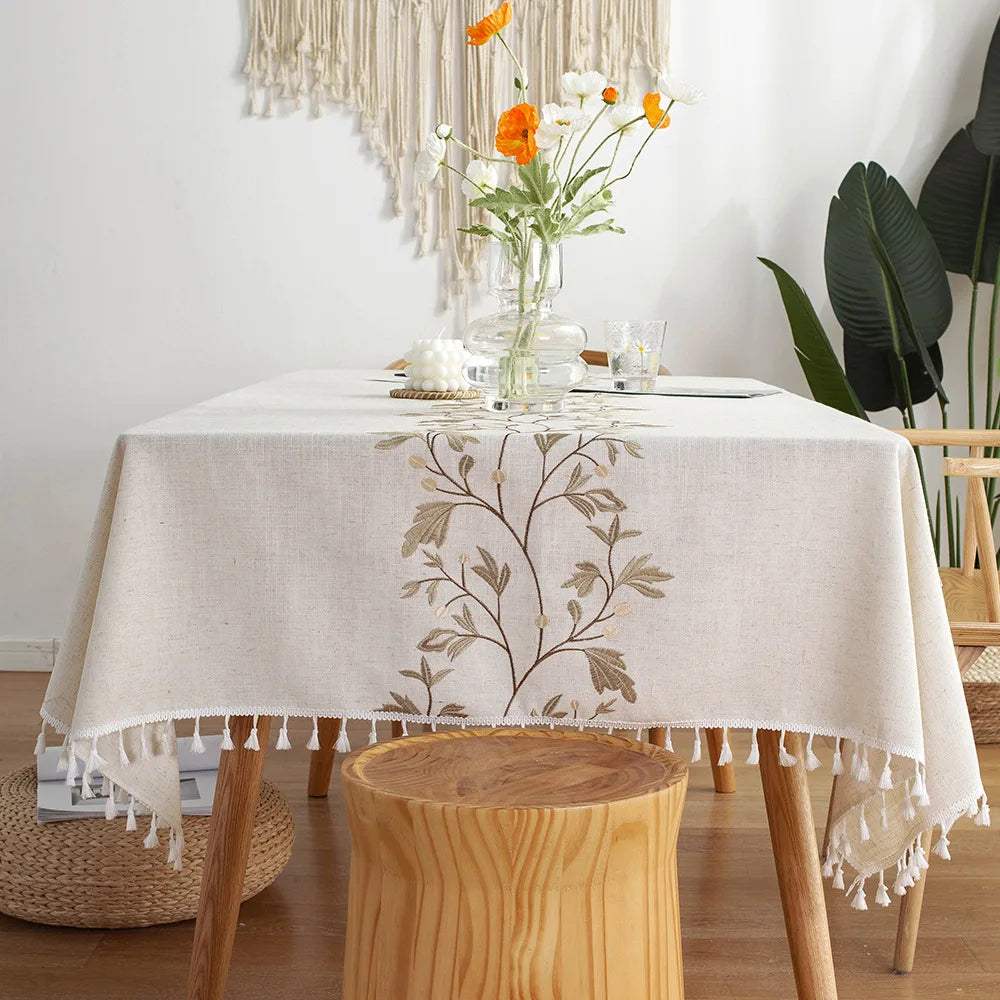
The rectangular tablecloth is available, notably, in 140 × 220 cm. On a 180 × 90 cm table, it provides about 20 cm at the ends and 25 cm on the sides: a very balanced proportion for everyday use.
The stain-resistant rectangular tablecloth is available, notably, in 150 × 240 cm. On a 180 × 90 cm table, the drop reaches approximately 30 cm all around, with a more generous look.
The choice between these two formats therefore depends less on an absolute rule than on the desired effect: the 140 × 220 cm prioritizes everyday practicality; the 150 × 240 cm gives more presence to the textile.
The most common mistakes when choosing
- Taking a tablecloth the same length as the table: a 180 cm tablecloth on a 180 cm table has no drop at the ends.
- Forgetting the width: it determines the drape on the two long sides.
- Choosing solely based on the number of place settings: two six-person tables can have very different dimensions.
- Always taking the largest size: too much fabric can hinder legs, chairs, or young children.
- Measuring an extendable table in only one configuration: check at least the closed position and the one you use for entertaining.
Another point to watch out for: textile dimensions can sometimes have slight tolerances depending on manufacturing and care. It is therefore preferable to think in terms of a drop range rather than the exact centimeter. A tablecloth that drops 23 cm on one side and 25 cm on another remains visually perfectly consistent.
Frequently asked questions
After choosing the size: think about care
If you choose a coated tablecloth or an oilcloth for daily use, storage creases may require a little patience when unpacking. Our guide on how to de-crease an oilcloth tablecloth details the gentle methods to prioritize. You can also browse our tablecloth collection.
The simplest choice to remember
To avoid getting lost in dimensions, remember one rule: measure the table and add 20 to 30 cm to each side. Twenty to twenty-five centimeters is suitable for most daily meals; thirty centimeters creates a more elegant look.
Then, adapt the result to the closest standard format. The perfect size is not necessarily the one that matches the calculation to the exact centimeter, but the one that gives the drop you want without disturbing guests.