




Daily meals
Opt for a moderate drop, a format that is easy to set up, and a material compatible with frequent cleaning.
The oval tablecloth should be chosen to match the tabletop dimensions and the drop you want. For a 100 × 160 cm tabletop with a 20 cm drop, compare a 140 × 200 cm size, then check the model’s exact shape. Include any table extensions in your measurements if you use them.
Then compare surfaces: fabric for its drape, oilcloth for wipe-clean care, or a treated model whose composition and care instructions need checking. Each product page details its options so you can choose an oval tablecloth suited to your table and everyday meals. For a wipe-clean surface, compare the options on the oval oilcloth tablecloth page. You can also compare the tablecloth for an oval table offered in three sizes with your tabletop dimensions.
First, measure the total length of the tabletop from one end to the other. Then measure its maximum width in the center. Finally, choose the drop you want to see fall over the edge. To get a first reference point, add twice this drop to the length and width.
For example, a 160 × 100 cm table with a 25 cm drop requires approximately 210 × 150 cm. However, the actual curve of the tabletop may slightly modify the look at the ends. This is why you must compare the exact dimensions of the tablecloth and, when the product page allows it, observe its shape rather than relying solely on the length × width pairing.

Length → width → drop. This sequence allows you to compare available formats without starting from an approximate number of guests. A six-person table can be short and wide or long and narrow.
If your tabletop is more circular than truly oval, the round tablecloth collection provides a calculation method more suited to the diameter.
For daily use, a drop of about 20 to 30 cm on the sides often offers a comfortable result. It dresses the table without falling excessively on knees. For a reception, you may look for more length if the legs and chairs provide enough space.
The ends deserve special attention. On some tables, the radius of the curves is very gentle; on others, the tabletop looks almost like a rectangle with very rounded corners. The same tablecloth format can therefore result in different drops. If you are unsure, use a sheet or a piece of fabric for which you know the dimensions to simulate the result.
An oval 160x200 tablecloth does not automatically correspond to a 160 × 200 cm table. These may be the dimensions of the tablecloth itself. Always check whether the figures refer to the product or the target tabletop.
Opt for a moderate drop, a format that is easy to set up, and a material compatible with frequent cleaning.
On a large oval tabletop, the regularity of the drop is more visible. Take the time to measure both axes and check the available length.
A coated or waxed finish can be interesting if splashes are frequent, provided that the recommendations specific to the product are followed.
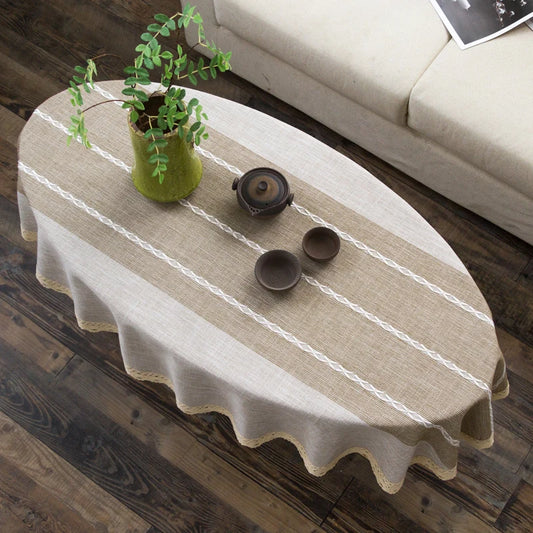
A soft textile tablecloth highlights the shape of the table thanks to a fluid drop. Cotton or linen-look materials are particularly suitable when the table is used for entertaining or when the tactile feel is a major part of the decoration.
Treated fabrics or easy-to-wipe surfaces can simplify daily life. A 160x200 oval stain-resistant tablecloth can be interesting, for example, if its variant matches your table, but the term "stain-resistant" should not be understood as an absolute guarantee. Consult the product page and act quickly after a splash.
For a surface that is easier to clean with a sponge, an oval oilcloth tablecloth might be suitable. The oilcloth tablecloth collection delves deeper into this type of material, while the waterproof tablecloth collection is more focused on protection against liquids.
Textiles generally prioritize the drop and tactile feel. A waxed or coated surface prioritizes quick cleaning. No choice is superior in all cases: the best one depends on your meals, children, washing frequency, and the desired style.
For a more general approach before choosing the shape, the tablecloth collection compares the main uses and materials.
A rectangular tablecloth can be placed on an oval table, but it creates four longer zones of fabric around the theoretical corners of the rectangle. This effect can be intentional and decorative. If you are looking for a drop that follows the curves and appears more regular, the oval shape remains more intuitive.
Conversely, some "oval" tables are actually rectangular tables with large rounded corners. In this case, a rectangular tablecloth can also work depending on the desired drop. Look at the actual silhouette of the tabletop rather than its commercial name.
A tablecloth for an oval table must therefore be chosen based on the dimensions of the variant and not simply because its name contains "oval".
A plain and soft tablecloth creates an elegant contrast with the wood. Ecru, beige, soft green, or terracotta tones work easily with natural fibers. If you wish to show more of the tabletop, a table runner placed lengthwise can replace a full covering.
The placemats also allow you to protect dining areas while leaving a large portion of the wood visible.
You can bring more texture or contrast with a dark tablecloth, a subtle pattern, or a textured textile. A white tablecloth, on the contrary, offers a very luminous result and allows you to work with color through tableware.
Keep the centerpiece decoration quite long and low in order to naturally follow the axis of the table without disturbing the guests.
The oval shape combines the length of a rectangular table and the softness of a round table. Take advantage of this axis to distribute several small elements in the center rather than one large bouquet. Three small vases, a few low candles, or an elongated floral arrangement create a rhythm consistent with the tabletop.
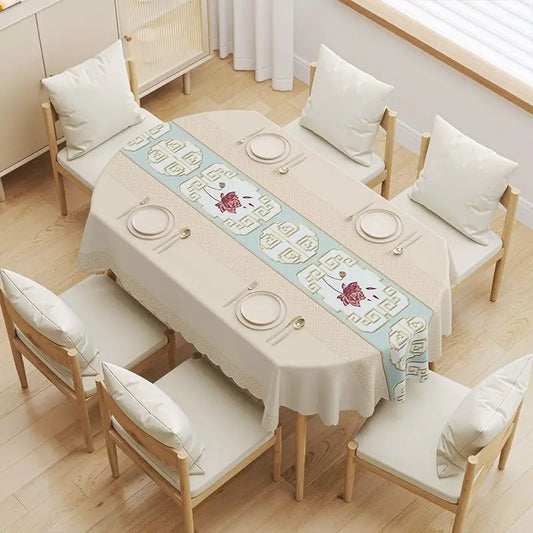
A table runner placed lengthwise reinforces this effect. If the tablecloth already has a strong pattern, choose a plain runner or remove it completely. Placemats should remain sufficiently spaced at the ends, where the usable width of the tabletop decreases.
For entertaining, check the space needed for dishes before setting up the decoration. An elegant table must be able to function when all the meal elements are installed.

On an oval table, the drop visually accompanies the curve. A well-centered and properly sized textile looks neater than a tablecloth chosen solely according to a size category.
Before the meal, align the tablecloth on the long axis then adjust laterally. This small check prevents a significantly longer drop on one side.
Always follow the product label. For a machine-washable textile, respect the recommended temperature, spin, and drying settings. Do not overload the drum: a large tablecloth needs space to be properly agitated and rinsed.
For an oilcloth or a wipeable surface, remove residues then use a sponge or a non-abrasive cloth with a compatible product. Avoid solvents and aggressive products likely to alter the finish. For a stain on textile, dab before washing and adapt the treatment to the fiber.
Before storing, make sure the tablecloth is completely dry. Waxed surfaces can show crease marks; if you have space, rolled storage or large folding can limit persistent marks.
Measure the length and maximum width of the tabletop, then add twice the desired drop to each of these dimensions.
About 20 to 30 cm per side is suitable for many daily uses. You can choose more for a reception if the chairs and legs allow it.
Yes, but the fabric will form longer points in certain areas. If you are looking for a drop that follows the curves better, an oval tablecloth is generally more harmonious.
Opt for a material whose cleaning matches your habits. A wipeable surface can be practical; a textile might be preferable if touch and drop are priorities.
Align the length of the tablecloth with the long axis of the table first, then adjust laterally to obtain a similar drop on both sides.

Choose a bed throw that fits your bed and room. Measure its width, calculate the drop and compare sizes for decoration or fuller coverage.
Choose a bed throw that fits your bed and room. Measure its width, calculate the drop and compare sizes for decoration or fuller coverage.

Why does your duvet move inside its cover? Check the size, align the corners and try eight practical ways to keep your duvet in place.
Why does your duvet move inside its cover? Check the size, align the corners and try eight practical ways to keep your duvet in place.

Keep your tablecloth in place with the right size, a non-slip protector, clips or weights. Useful solutions for indoor and outdoor tables.
Keep your tablecloth in place with the right size, a non-slip protector, clips or weights. Useful solutions for indoor and outdoor tables.
