How to match your cushion covers to your sofa?
Louis MikolajczakHow to Match Your Cushion Covers with Your Sofa for a Harmonious Living Room
Matching cushion covers with a sofa becomes much simpler when you separate three decisions: the sofa's color, the materials already present in the room, and the truly comfortable quantity of cushions. The goal isn't to match everything perfectly, but to create enough echoes so that the textiles feel like they belong to the same living room.
This guide focuses on color and style coordination. To work primarily on the number of cushions, formats, and a less "catalog-like" look, consult how to mix sofa cushions without a catalog effect. And if you're also adding a throw or blanket, the guide cozy living room: combining sofa throws and cushion covers completes the composition.
Table of Contents
Start with the sofa's style and color
The sofa occupies a large visual area: it should serve as a base, not be competed with by cushions. A minimalist sofa can accommodate a more pronounced texture; a sofa that is already very elaborate often benefits from simpler covers.
Linen, washed cotton, small geometric patterns or soft solids. Light grays, sages, misty blues, and mustard accents can work depending on the rest of the room.
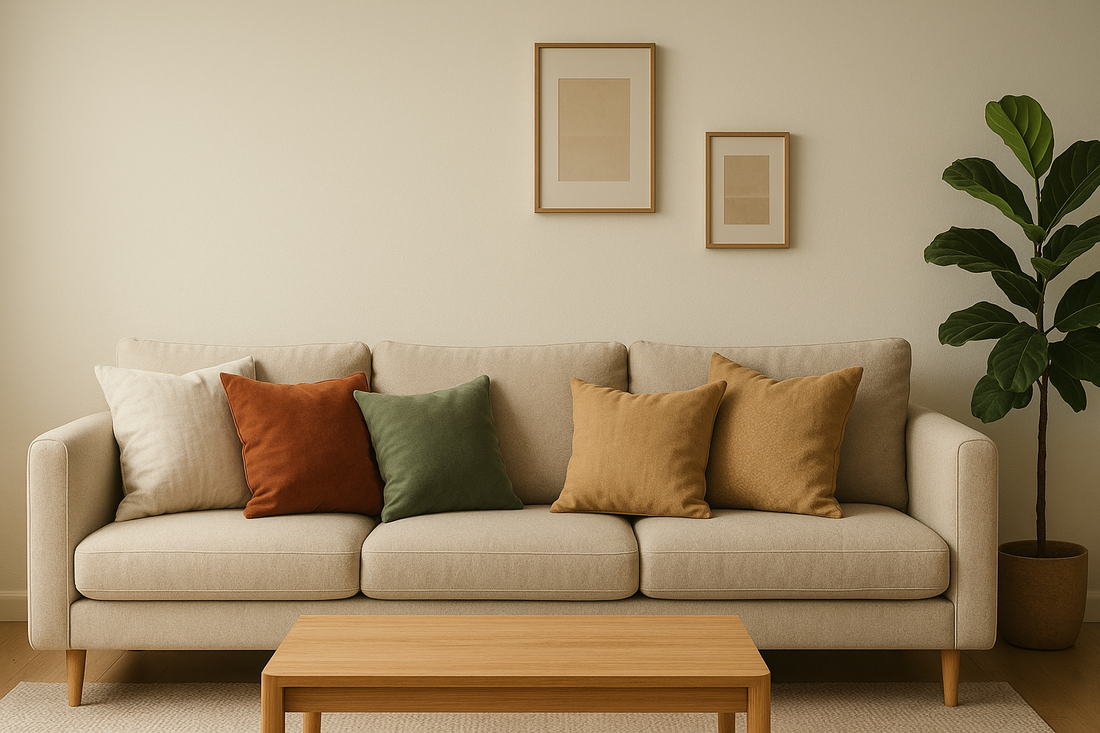
Visible textures, earthy tones, off-white, olive, or terracotta. If the sofa already has a lot of texture, limit competing patterns.
Solid or faux-solid covers, with a material contrast rather than a multitude of colors.
Velvet, subtle jacquard, piping, or richer shades can add character without covering the entire seating area.
Match or contrast colors?
Two approaches work: staying in similar tones for a calm atmosphere, or introducing contrast to add dynamism. There's no mandatory ratio like "60/30/10": this type of rule can serve as a guide, but light, sofa size, and existing colors matter more.

Some color families to build a coherent palette around the sofa.
| Sofa | Easy-to-match covers | Possible effect | To watch out for |
|---|---|---|---|
| Light grey | Off-white, beige, sage, mustard as an accent | Light and warm | Too many identical grays can flatten the whole look |
| Beige / sand | Terracotta, olive, camel, off-white | Natural and soft | Add texture if the palette is very similar |
| Navy blue | Off-white, caramel, deep red in a small touch | Elegant contrast | Avoid darkening all surrounding surfaces |
| Forest green | Off-white linen, taupe, honey | Natural and enveloping | Adjust the amount of dark tones to the light |
| Anthracite | Off-white, cognac, grey-blue | Graphic and bright | Keep some lighter surfaces |
| Camel leather | Textured off-white, slate blue, rosy taupe | Warm and balanced | Avoid multiplying very similar orange tones |
If you like earthy palettes, our guide earthy colors in decor: how to adopt them without darkening helps to balance terracotta, brown, and ochre throughout the room.
Mix materials in moderation
Material creates relief even when colors are very similar. A smooth sofa can accommodate linen, velvet, or a boucle texture; a sofa that is already very textured often benefits from more sober covers.
- Linen or washed cotton: flexible and natural look.
- Velvet: deeper light and more enveloping feel.
- Thick weave or boucle: significant texture, to be used in moderation if the sofa is already voluminous.
- Twill or faux solid: a good base when the main focus is on color.
Two families of textures can be enough to create depth. A third can serve as an accent, but it's not a requirement.
Use patterns without oversaturating
A strong pattern immediately draws the eye. If the rug, curtains, or sofa already have a distinct design, choose calmer covers. Conversely, in a very neutral living room, a stripe, a discreet checkerboard, or a botanical pattern can become the accent point.
A simple method is to keep one dominant pattern, then surround it with solids or calmer textures. If you combine several patterns, make them interact through a common color and different scales.
Adjust the number and arrangement of cushions
The number of cushions depends on the sofa's width, depth, and how it's used. Rather than imposing "4 on a three-seater" or "7 on a sectional sofa," stick to a practical rule: the seating area must remain immediately usable.
Varying two formats already creates rhythm. Large cushions can stay at the back, smaller or rectangular ones at the front. A symmetrical composition appears more formal; a slightly asymmetrical arrangement gives a more relaxed look.

The arrangement can evolve depending on the volume of the sofa and the space you want to keep for sitting.
To delve deeper into this section only, consult sofa cushions: mix them without a catalog effect.
Update covers according to seasons
It's not necessary to change your entire decor four times a year. A stable base can remain in place, and one or two covers can vary in color or texture.
The guide season by season: switch your covers without buying everything new offers a capsule method for reusing the same inserts and limiting storage.
Care for and extend the life of covers
Turning a cover inside out before washing can protect certain surfaces, but the essential rule remains to follow each product's label. Velvet, linen, cotton, embroidery, or piping may require different care.
Before storing a seasonal cover, ensure it's clean and perfectly dry. Store it away from humidity and reuse the same insert if the dimensions match.
Conclusion
To match your cushion covers with your sofa, start with the sofa's color and style, then choose a few materials and accents that echo the rest of the room. The most coherent result isn't necessarily one where everything matches; it's one where each cushion has a visible connection to the whole.