
Which tablecloth for a successful Easter table? (materials, sizes, drape) Corner: size guide + “perfect drape” + care.
Louis MikolajczakThe Easter table that makes you "wow": it all starts with the right tablecloth
Choosing a tablecloth for Easter isn't just about "putting fabric on a table." It's what instantly sets the style: a chic table, a rustic table, a pastel table, a natural table… and above all, a table that's a pleasure to use. The real problem is that we often get three things wrong: the material (too delicate or too stiff), the size (too short or too long), and the drape (not harmonious, not practical). In this guide, you'll learn how to choose the perfect tablecloth based on your table (round, rectangular, oval), the number of guests, the Easter atmosphere you want, and your level of "stain tolerance." You'll also find a ready-to-use size chart, tips for a perfect drape , and a simple maintenance routine after the meal (chocolate, grease, wine…).
- Why the tablecloth changes the whole Easter table
- Quick choice: the perfect tablecloth to suit your style and your meal
- Materials: linen, cotton, coated fabric… which one for Easter?
- Size guide: choosing the right size without making a mistake
- Perfect drop: how many centimeters should you drop?
- Round tables, oval tables, extendable tables: special cases
- Table setting: creating a harmonious Easter table (without overcrowding)
- Post-Easter care: stains, washing, ironing
- To avoid: mistakes that ruin a pretty tablecloth
- Frequently Asked Questions
- Quick memo
A well-chosen tablecloth is often enough to set the mood: natural, chic, or pastel… without overdoing it.
Why the tablecloth changes the whole Easter table
A tablecloth does two things at once: it dresses and structures . It provides a visual base (the dominant color), it softens the light, and it makes the table look more "finished." Even with simple dishes, a quality tablecloth gives the impression of a carefully set table.
And for Easter, this is even more true: we often have a longer meal, with chocolate, sauces, dishes to share, children… So the tablecloth must be pretty, yes, but also suitable for real use : it must stay in place, not get in the way of the chairs, and not make you want to cry at the first stain.
Quick choice: the perfect tablecloth to suit your style and your meal
If you want to get straight to the point, here are some simple guidelines. Then we'll go into detail (materials, sizes, drape, care).
You want a "natural & chic" table setting (very Easter-like)
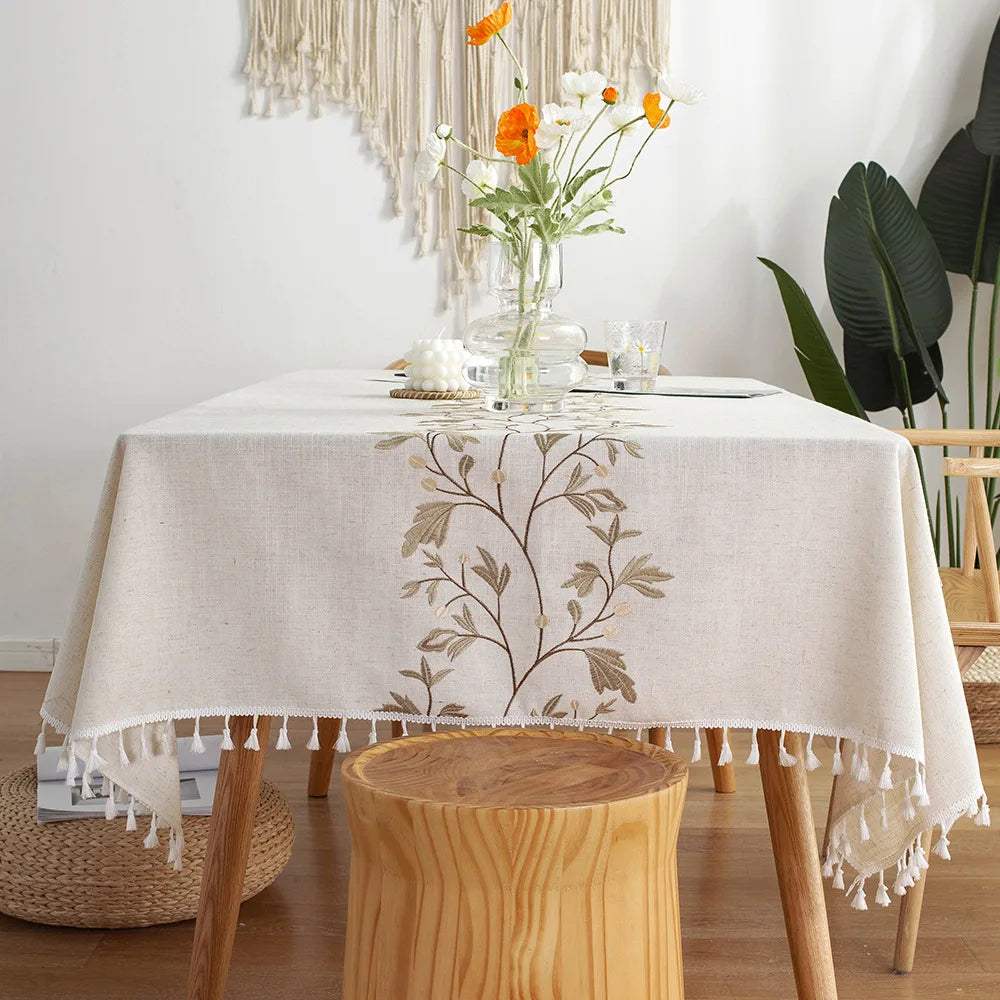
Linen or heavy cotton , in ecru, off-white, beige, or sage green. Medium drop (25–30 cm). Add 2–3 elements: candles, flowers, and you're done.
You want a "practical" table (children, chocolate, live food)
A coated or stain-resistant tablecloth. Visually, it can be very attractive if you choose a textile effect (not shiny). A short overhang (20–25 cm) to prevent it from dragging.
You want a “very elegant” table setting (for a quieter meal)
Washed linen or high-quality cotton , with a longer drape (30–35 cm) and a beautiful harmony of tones. Avoid overly bold patterns: elegance often lies in the fabric.
Materials: linen, cotton, coated fabric… which one for Easter?
The right choice isn't "the best material in the world." It's the material that suits your Easter meal and your everyday life. Here are the most useful options, along with their advantages and pitfalls.
Linen: the most beautiful "festive table" look
Linen instantly lends a chic and natural style. It drapes beautifully, catches the light, and effortlessly creates a polished, homey atmosphere. It's a popular choice for a successful Easter table setting, especially if you like soft tones: ecru, off-white, beige, sage green.
- Strengths : high-end, natural, timeless finish.
- Note : it wrinkles (that's part of its charm). It requires a little more attention when it comes to grease stains.
Cotton: simple, effective, easy to live with
Cotton is often the best compromise: pleasant, easy to wash, and less "stressful" than linen. It comes in lightweight cotton (more fluid) or heavier cotton (more "table-like").
- Strengths : easy to maintain, wide choice of colours, good budget.
- Note : cotton that is too thin can "mark" the creases and move more easily.
The coated tablecloth: the queen of the family table
For Easter, whether you're with children or planning a very indulgent meal, a coated tablecloth can be a lifesaver. It wipes clean with a sponge and prevents melted chocolate disasters. The secret is to choose a coating that maintains a textile feel , not a shiny, plastic finish.
- Key features : ultra practical, stain-resistant for everyday use, ideal for lively meals.
- Note : some coated tablecloths do not like ironing and high temperatures.
Size guide: choosing the right size without making a mistake
The method is always the same: you measure the table , then you add the overhang. It's as simple as that.
The quick formula
Tablecloth length = table length + (2 × overhang)
Tablecloth width = table width + (2 × overhang)
Example: table 160 × 90 cm, overhang 30 cm → ideal tablecloth = (160 + 60) × (90 + 60) = 220 × 150 cm .
| Table type | Table size | Recommended outcome | Recommended tablecloth size | Handy tip |
|---|---|---|---|---|
| Rectangular | 120 × 80 cm | 25–30 cm | 170/180 × 130/140 cm | Perfect for 4 people |
| Rectangular | 140 × 90 cm | 25–30 cm | 200 × 150 cm | Ideal if you want a nice drape |
| Rectangular | 160 × 90 cm | 25–30 cm | 220 × 150 cm | Very common format |
| Rectangular | 180 × 100 cm | 25–30 cm | 240 × 160 cm | Comfortable for 6–8 people. |
| Rectangular | 200 × 100 cm | 25–30 cm | 260 × 160 cm | Perfect for large gatherings |
| Round | Ø 100 cm | 25–30 cm | Ø 160 cm | A smooth, harmonious transition without any discomfort. |
| Round | Ø 120 cm | 25–30 cm | Ø 180 cm | Very nice "party table" effect |
| Round | Ø 140 cm | 25–30 cm | Ø 200 cm | For a large table, chic look |
If you are between two sizes, often take the larger size to keep a regular drape… unless you have children who easily pull the tablecloth (in which case, a shorter drape).
Perfect drop: how many centimeters should you drop?
The drape is what transforms a "decent" tablecloth into a "fantastic" one. Too short: it looks sad. Too long: it's awkward, it gets dirty, it snags on your knees. Here are some simple guidelines.
The 3 most effective outcomes (depending on the use case)
- 20–25 cm : perfect if you want a practical table (children, lively meal, chairs close together).
- 25–30 cm : the “ideal” drop for most Easter tables.
- 30–35 cm : looks more dressed up, more “party”, to be preferred if the space is comfortable.
The simple test before Easter
Sit down at the table and check two things:
1) The tablecloth doesn't touch your knees when you move.
2) The tablecloth does not get caught in the armrests or chair legs
If it catches, shorten the drop or change size: comfort must remain the priority.
Round tables, oval tables, extendable tables: special cases
Round table: the tablecloth should fall “regularly”
On a round table, the overhang is immediately noticeable. A tablecloth that's too small gives a "doily" effect, while one that's too large gives a "curtain" effect. The guidelines in the table above work very well. If you want a truly elegant table setting, aim for a 30 cm overhang (if it's not an issue).
Oval table: think “maximum dimensions”
Measure the longest length and the widest width, then apply the formula. An oval table works very well with a rectangular tablecloth, as long as the overhang remains balanced.
Table with extension: choose your strategy
There are two options, and both are good:
- Option 1 : tablecloth provided for the open table (on Easter day, it's tranquility).
- Option 2 : “standard” tablecloth + table runner or placemat in the center to hide the join.
Table setting: creating a harmonious Easter table (without overcrowding)
A successful Easter table is rarely a table overflowing with food. It's a table that breathes. The tablecloth should be the foundation, and the decorations should simply complement it.
Color harmonies that always work
- Sage green + white + wood : very fresh, very “spring”, easy to achieve.
- Beige + off-white + white flowers : chic, bright, timeless.
- Soft pastel (powder pink, pale yellow, soft green): perfect for a family atmosphere.
The simple rule: a maximum of 3 materials
An easy example: linen (tablecloth) + ceramic (plates) + glass (glasses). Then add a small natural touch: wood, flowers, or candles. Any more than that and it quickly becomes "too much".
Post-Easter care: stains, washing, ironing
Easter is the perfect recipe for stains: chocolate, grease, wine, candle wax, sauce… The important thing isn't to have a tablecloth that's "impossible to stain." The important thing is to know what to do quickly .
Reflex 1: Act without rubbing
We dab, we absorb, then we treat. Rubbing spreads the stain and damages the fibers.
Reflex 2: treat before washing (especially grease)
Grease tends to set in during washing if you don't do anything beforehand. Put a drop of dish soap (very little) on the stain, add a little warm water, dab, then wash.
Reflex 3: chocolate
Let it cool, remove the excess, then rinse with lukewarm water and mild soap. Avoid very hot water at first: it can "cook" the chocolate into the fibers.
| Stain | Immediate reflex | Gentle cleaning | Avoid | Advice |
|---|---|---|---|---|
| Chocolate | Remove the excess, dab | Warm water + mild soap | Direct boiling water | Treat before washing |
| Fat / sauce | Absorb (paper), do not rub | A drop of diluted dish soap | Washing without pre-treatment | Fat sets if you wait |
| Wine | Dab immediately | Cold water followed by mild soap | Rub hard | The longer you wait, the more it will make an impression. |
| Candle wax | Allow to harden | Scrape gently + absorbent paper + warm iron | Scrape it off when it's liquid | The paper “absorbs” the wax |
If your tablecloth is linen: accept that it has a bit of a history. A beautiful party tablecloth often has a story to tell… as long as it remains clean and attractive.
The "just right" drop (neither too short nor too long) immediately gives a more elegant look.
To avoid: mistakes that ruin a pretty tablecloth
- A tablecloth that is too long : it catches on your knees, gets dirty quickly, and makes the table less comfortable.
- A tablecloth that is too small : it creates a "doily" effect, especially on a large table.
- A glossy finish : often it gives a plastic and less warm look.
- Too many patterns + too much decoration: the table becomes confusing.
- Forget about maintenance : a beautiful tablecloth will last a long time if you treat stains properly at the right time.
Frequently Asked Questions
What are the implications of an Easter table with children?
Aim for 20 to 25 cm . It looks nice, and it prevents the tablecloth from being pulled or dragging on the floor.
How do I choose a tablecloth if my table is between two sizes?
If you want a "party" look: choose the next size up for a more generous fall. If practicality is your priority: choose the size closer to 25 cm of fall .
Linen or cotton for Easter?
Linen if you want a very chic and natural feel. Cotton if you want an easy-care tablecloth. Both work very well; it all depends on how you intend to use it and how easy it is to maintain.
Is a white tablecloth a bad idea for Easter?
Not at all. But let's be realistic: chocolate + sauce + kids… it leaves a mark. If you like white, you can choose an easy-to-wash fabric or a treated material. And keep a simple plan for dealing with stains: blot, pre-treat, wash.
How to create an elegant Easter table without buying lots of things?
A beautiful tablecloth, simple tableware, and a touch of nature (flowers, branches, candles) are all you need. The consistency of the tablecloth and colors accounts for 80% of the result.
Quick memo
- Measure the table then add the overhang: tablecloth = table + (2 × overhang).
- For Easter, the easiest drop: 25–30 cm .
- Linen = natural chic, cotton = easy, coated = family top.
- A harmonious table setting = a maximum of 3 colors + a few well-chosen elements.
- Treat stains quickly, especially grease, to keep your tablecloth looking beautiful for a long time.