
Linen, Cotton or Polyester Tablecloth Guide
Louis MikolajczakShare
Linen, Cotton, or Polyester Tablecloth: How to Choose the Right One for Your Needs
Between a linen tablecloth, a cotton tablecloth, and a polyester tablecloth, there isn't one material that wins in all situations. The best choice depends on the desired aesthetic, frequency of meals, desired level of maintenance, and budget.
This comparison plays a different role than our guide dedicated solely to daily use: here, we compare the three main material families globally. If your priority is a table used morning, noon, and night, consult which tablecloth material to choose for daily use instead.
Summary
1. Key Differences2. Advantages and Limitations3. Choosing Based on Your Priority4. Maintenance: What Really Changes5. Pairing Material with Table StyleConclusion1. Linen, Cotton, or Polyester: Key Differences
| Material | Look | Main Advantage | Consideration |
|---|---|---|---|
| Linen | Textured, natural, subtly dynamic | Elegance and depth | Wrinkling is more visible and maintenance varies by model |
| Cotton | Soft, familiar, very versatile | Good balance between style and practicality | May wrinkle or shrink depending on weave and washing |
| Polyester | More uniform, often less prone to wrinkling | Easy care and quick drying | Feel and look can vary in naturalness depending on quality |
The choice is not simply "natural vs. synthetic." A tablecloth must primarily function on your actual table. Beautiful linen can be perfect for entertaining and too demanding for some daily uses; good quality polyester can be very practical in an active home without matching the desired look for a reception.
2. Advantages and Limitations of Each Material
Linen
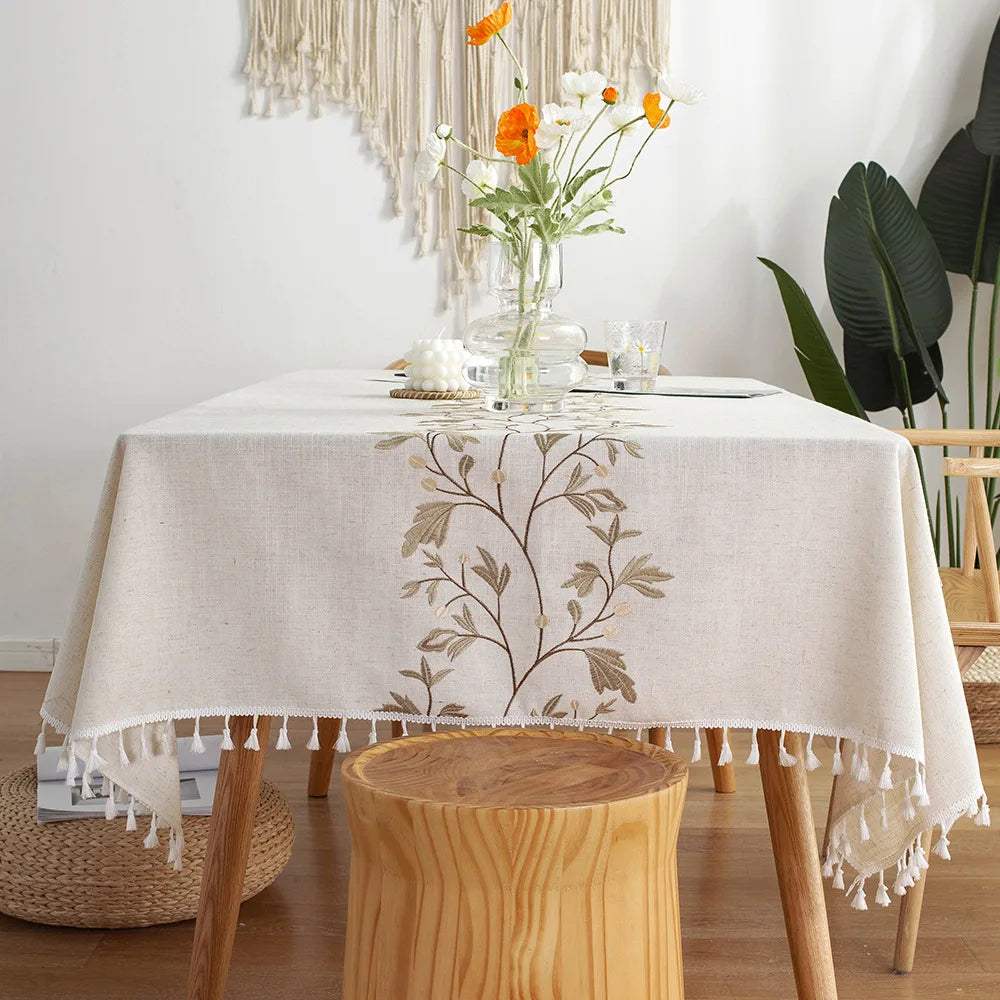
Linen immediately adds texture to a table. It is particularly suitable for natural atmospheres, wedding tables, more formal meals, and décors where the material itself plays a visual role.
Its slightly wrinkled appearance can be embraced. If, on the other hand, you are looking for a perfectly smooth surface at all times, it will require more attention.
Cotton
Cotton is probably the easiest solution to integrate into very different styles. It is available in many weights, weaves, colors, and patterns. Its maintenance generally remains simple, but you must follow the label: two cotton tablecloths can react differently to washing.
Polyester
Polyester is interesting when looking for a textile that dries quickly and wrinkles little. Some models have a very matte and discreet finish, while others appear more technical. Therefore, the finish should be considered as carefully as the composition.
3. Choosing Based on Your Priority
- For a very natural table or a reception: linen is often the most visually expressive.
- For a balance between appearance and maintenance: cotton remains very versatile.
- To minimize constraints and drying time: polyester can be the most practical.
- For an outdoor table: do not choose solely based on the fiber. Also consider the finish, resistance to use, and storage instructions. Our guide which material to choose for an outdoor tablecloth in summer addresses this specific case.
Budget should not be interpreted as an absolute rule: manufacturing quality, weave, dimensions, and finishes can significantly vary the price within the same material.
4. Maintenance: What Really Changes
The most important rule is simple: the product label takes precedence. Avoid generalities such as "all polyester can withstand high temperatures" or "all linen must be ironed hot": dye and finishes can completely alter the recommended maintenance.
- Linen: opt for washing suitable for the model and avoid overloading the machine with a large tablecloth.
- Cotton: check the allowed temperature and pre-treat stains before washing.
- Polyester: a moderate cycle is often sufficient; excessive heat generally adds nothing to routine maintenance.
For natural fibers, our guide how to properly care for and remove stains from a linen or cotton tablecloth provides a more detailed method.
5. Pairing Material with Table Style
The material becomes more legible when paired with the right tableware. Textured linen works well with stoneware, simple porcelain, or clear glass. A solid cotton easily accommodates more pronounced patterns on napkins or the table runner. A very understated polyester can serve as a neutral base for a more colorful decoration.
If you are using a table runner, consult how to set a table runner. To browse available models without limiting yourself to one material, discover our collection of table linens.
Conclusion
Choose linen if texture and natural elegance are priorities, cotton if you are looking for a versatile solution, and polyester if you prefer ease of maintenance and minimal wrinkling. The right material is one that matches your table, your usage, and the time you genuinely want to dedicate to maintenance.