
Pair Tableware with a Linen Tablecloth: Ideas
Louis MikolajczakTableware: Perfect Pairings with a Linen Tablecloth, No Faux Pas Allowed
Linen is beautiful… but it's also a material that doesn't forgive "almost-right." A linen tablecloth highlights everything: the color of the plates, the gleam of the glasses, the finish of the cutlery, and even the centerpiece. In this article, I'll give you a clear method for creating pairings that immediately look chic (even with a simple dinner set), and most importantly, the common mistakes that spoil the whole look. You'll leave with ready-to-copy combos, a summary table, and a checklist for setting a perfect table in 10 minutes.
- Why Linen Completely Changes a Table's Ambiance
- Choosing the Right Linen Tablecloth: Color, Drape, Dimensions
- The Rule That Prevents 80% of Mistakes: "Only One Star"
- Color Pairings Tablecloth + Tableware: From Simplest to Most Elaborate
- Materials and Finishes: Porcelain, Stoneware, Glass… How to Make Them Coexist
- Glasses and Cutlery: The Details That Make a "Restaurant Table"
- Napkins, Rings, Folds: Little Effort, Big Impact
- Centerpiece and Decor: Maintaining Style Without Clutter
- Summary Table: Winning Pairings and Pitfalls to Avoid
- Mistakes That Spoil Everything (and How to Fix Them)
- "Perfect Table" Checklist in 10 Minutes
- Linen Care: Avoiding Sad Wrinkles, Stains, and Unpleasant Surprises
- Frequently Asked Questions
- Quick Memo
Why Linen Completely Changes a Table's Ambiance
A linen tablecloth isn't just "a piece of fabric on the table." Linen has a living texture, a material that catches the light, folds that are part of its charm… and a natural side that can make a table ultra warm or, conversely, a bit "flat" if the rest doesn't follow suit.
Specifically, linen amplifies three things:
- Contrasts: A plate that's too white on an ecru linen can look yellowed or "dirty" (even when everything is clean).
- Finishes: A glass that's too thick or cutlery that's too shiny stands out more.
- Volume: If everything is flat (basic dinner set + neutral tablecloth + timid decor), the overall look lacks dimension.
The Right Approach
With a linen tablecloth, you're looking for a balance between softness (natural material) and structure (clean shapes, consistent finishes). This doesn't mean "matching everything"; it means connecting everything.
Choosing the Right Linen Tablecloth: Color, Drape, Dimensions
1) Color: Think "undertone," not just "beige or white"
The number one pitfall is choosing a "neutral" tablecloth without considering its undertone. Linen can lean towards:
- warm (golden beige, sand, ivory)
- cool (greyish ecru, cool off-white, "pebble" linen)
- rosy (champagne, nude)
- green/grey (sage, smoked linen)
Then, your dinner set should stay within the same family. You can contrast, yes, but not "warm vs. cool" without a clear intention. This is exactly the kind of detail that makes a table look "odd" without knowing why.
2) Drape: The tablecloth should have body
Linen that's too thin can look like "light fabric" and lack elegance, especially if you want a slightly dressed-up table. Conversely, very thick linen creates a magnificent presence, but you have to accept it: it has a more structured drape and more pronounced folds.
3) Dimensions: The overhang changes everything
A tablecloth that's too short immediately makes the table look "unfinished." A tablecloth that's too long can get in the way of knees and make the table visually heavy.
Simple Rule of Thumb (almost always works)
Ideal overhang: 20 to 30 cm on each side (a little more for a reception table, a little less for everyday meals).
Tip: If you're debating between two sizes, choose the larger one for a "dressed-up" table, the smaller one for a "simple and neat" look.
To convert this guideline into concrete dimensions, our guide what size tablecloth for a rectangular table provides the main formats and overhangs without needing to recalculate every time.
The Rule That Prevents 80% of Mistakes: "Only One Star"
When a table looks bad, it's not because "it's not pretty." It's often because everything is trying to be pretty at the same time.
The simplest rule: choose only one star (one element that catches the eye) and let the rest support it.
The 3 Easiest "Star" Options
- Star = the tablecloth: colored linen (terracotta, sage green, charcoal gray) → rather simple dinner set.
- Star = the dinner set: plates with texture, colored rim, artisanal stoneware → rather plain tablecloth.
- Star = the centerpiece: bouquet + candles + materials → more subtle tablecloth and dinner set.
You can have two strong elements only if one is very calm (e.g., terracotta tablecloth + very simple white plates). Three strong elements = high risk.
Color Pairings Tablecloth + Tableware: From Simplest to Most Elaborate
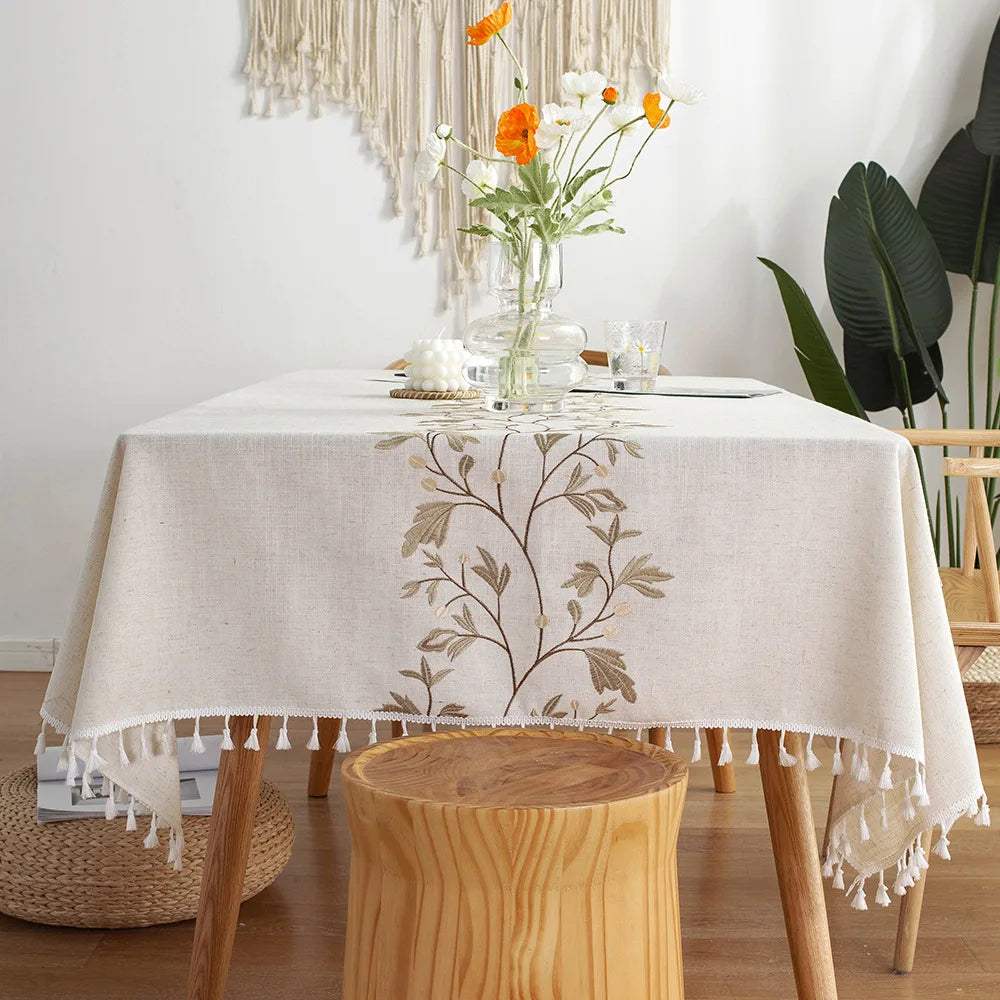
Pairing n°1 (easy and chic): Natural linen + white porcelain + clear glass
This is the "safe bet" combo, but there's one condition: the porcelain must be a consistent white. A bluish white on warm linen can look too "cool." If your dinner set is very cool white, opt for a greyish ecru linen or a cool off-white linen.
To add dimension: add a small touch of texture (wooden napkin rings, thin jute plate mats, ivory candles) or a soft contrast (light grey linen napkins).
Pairing n°2 (ultra warm): Golden beige linen + sand / cream stoneware
If you love natural tables, this is the perfect pairing: everything is in the same family, but the textures change. Stoneware adds dimension, linen adds softness. Here, avoid overly flashy cutlery: brushed stainless steel or slightly satin metal works better.
Pairing n°3 (modern): Off-white linen + black or charcoal plates
Very beautiful, very graphic… provided you go all in. If you choose black, own it: a simple centerpiece, rather thin glasses, and warm lighting (candles, soft light). Otherwise, it can quickly look "harsh."
Pairing n°4 (soft decor): Sage linen + ivory plates + slightly smoked glass
Sage green with ivory is simple and refined. Slightly smoked glass (very light grey) can add elegant depth. But be careful: if your plates already have a strong tint, keep the glasses clear.
Pairing n°5 (festive table without "overdoing it"): Champagne linen + discreet gold rim
The secret is "discreet." If you have plates with a fine gold rim, champagne or ivory linen is ideal. Don't add a thousand gold accessories: one accent is enough (a spoon, a ring, or a candle).
Avoid if you want a harmonious table
- Warm linen + very cool white: the overall look appears yellowish or dull.
- Patterned tablecloth + patterned plates + colored glasses: too much information, the eye gets tired.
- Too many "strong" colors: choose one dominant shade and a small accent, not five.
Materials and Finishes: Porcelain, Stoneware, Glass… How to Make Them Coexist
Porcelain: the most elegant, the "cleanest" visually
Porcelain is ideal if you want a bright and crisp table. On a linen tablecloth, it highlights the "well-kept home" aspect. If you want to break the overly classic effect, add a texture: crumpled linen napkins, a very simple but natural centerpiece, or slightly more contemporary glasses.
Stoneware: perfect with linen, but watch out for "all the same"
Stoneware and linen love each other because they are both lively. The risk: creating a table that's too uniform (all beige, all matte). To avoid this, add something that shines slightly: very clear glasses, satin cutlery, or a touch of lighter ceramic.
Earthenware: incredible charm, but watch the patterns
Earthenware (often decorated) can become the "star" of the table. In this case, use a plain linen tablecloth, rather understated napkins, and a light centerpiece. If your earthenware is very colorful, avoid tinted glasses: it quickly looks "too much."
Glass: the thinner it is, the more high-end the table appears
It's not mandatory to have "fragile" glasses, but the shape matters: a thin and simple glass immediately elevates the table. On linen, it creates a beautiful tension between the textile material (soft) and the transparency (crisp).
Glasses and Cutlery: The Details That Make a "Restaurant Table"
Glasses: 2 types are enough in 80% of cases
If you want an elegant table without complicating things: a water glass + a wine glass. Adding a flute, a cocktail glass, a digestif glass… can be nice, but it quickly clutters the table. And on a linen tablecloth, clutter is even more noticeable.
Simple tip: If your dinner set already has "presence" (textured stoneware, embossed plates), choose very simple and clear glasses. If your dinner set is very neutral, you can choose slightly more design-forward glasses (taller shape, thinner stem, slightly textured glass).
Cutlery: Choose one finish and stick to it
Cutlery is often where "things go wrong": mixing styles, metals, and polishes. Linen likes consistency.
- Shiny stainless steel: very classic, very bright. Works well with white porcelain.
- Brushed / satin stainless steel: softer, more modern. Perfect with stoneware and natural linen.
- Gold: superb if you keep it minimalist (only one gold accent, not an explosion).
- Matte black: modern, but to be used with a minimalist table (otherwise it looks harsh).
Simple Placement (no fuss)
Left: forks. Right: knife, blade turned towards the plate, then spoon if the menu requires one. Top right: glasses, from most used to most specific.
Napkins, Rings, Folds: Little Effort, Big Impact
Linen napkins: the simplest way to "finish" a table
If you already have a linen tablecloth, adding linen napkins (even in a different shade) creates a very cohesive look. The trick: stay within the same "temperature." For example:
- warm beige linen + soft terracotta napkins
- cool off-white linen + pearl grey napkins
- sage linen + ivory napkins
Folds that look good without being complicated
3 Quick Folds (for a "beautiful table" effect)
- The simple rectangle: fold in 3 lengthwise, place in the center of the plate or to the left of the cutlery.
- The loose knot: perfect with linen (natural). Make a soft, not tight, knot.
- The ring: slide the rolled napkin into a wooden, satin metal, or ceramic ring.
The "chic" crumpled linen look exists: the secret is a clean crumple (not a napkin pulled from the bottom of a drawer).
Centerpiece and Decor: Maintaining Style Without Clutter
The golden rule: you should see people, not the bouquet
A centerpiece that's too tall interrupts conversation and gives an impression of "too much." On a linen tablecloth, empty space is a luxury: let it breathe.
3 Easy Centerpieces (that go with linen)
- Option 1: candles + small touch of greenery (2 or 3 candles + a mini vase).
- Option 2: a light table runner (tone-on-tone linen) + low objects (small votives). For proportions and placement, also see how to use a table runner.
- Option 3: a low bouquet ( "just picked" style, not compact) in a simple vase.
The Classic Pitfall
Accumulating: bouquet + candles + large decorations + confetti + ribbons… Result: nothing looks good anymore. If you're unsure, remove 30% of the objects. The table will look chicer, almost every time.
Summary Table: Winning Pairings and Pitfalls to Avoid
| Linen Tablecloth | Recommended Tableware | Glasses & Cutlery | Ambiance | Avoid |
|---|---|---|---|---|
| Natural linen (warm beige) | Ivory porcelain or sand stoneware | Clear glass, brushed stainless steel | Warm, authentic | Very cool white, overly shiny stainless steel |
| Off-white linen (cool) | Cool white porcelain, minimalist plates | Thin glasses, shiny stainless steel | Clean, bright | Golden beige + bluish white (bad mix) |
| Sage green linen | Ivory plates, cream stoneware, subtle relief | Clear glasses, satin stainless steel | Softness, chic nature | Colored glasses + patterns on plates |
| Terracotta / Clay linen | Ecru/ivory plates (simple) | Clear glass, discreet gold touch | Warm, festive | Already very colorful dinner set, overly busy decor |
| Charcoal grey linen | White porcelain or very minimalist black plates | Clear glasses, satin metal | Modern, contrasted | Cool lighting, too many objects on table |
If you want to play it safe: plain tablecloth + simple dinner set + clear glasses + just one accent (napkin, candle, or small flower).
Mistakes That Spoil Everything (and How to Fix Them)
Mistake 1: Mixing "clashing" whites
On a linen tablecloth, white can quickly appear grey, yellow, or "faded." This isn't a defect of the tablecloth: it's a clash of undertones.
Solution: Maintain consistency: cool white with cool linen, ivory with warm linen.
Mistake 2: Too many patterns at once
Striped tablecloth + floral plates + colored glasses = overload. Even if each element is pretty on its own, the overall look becomes chaotic.
Solution: One strong pattern. The rest in solid colors or "faux-solids" (subtle texture).
Mistake 3: A "sadly" wrinkled tablecloth (not "chic" wrinkled)
Chic wrinkles are controlled wrinkles: clean tablecloth, lively fabric, soft folds. Sad wrinkles are a tablecloth pulled from a crumpled ball in a basket.
Solution: Quick steam iron or careful drying + neat folding. And most importantly: a perfectly clean tablecloth (linen shows marks).
Mistake 4: Centerpiece too tall or too massive
You can't see people, you don't know where to put dishes, and the table becomes "logistical."
Solution: Low and light. Thin candles + small vase, or low bouquet.
Mistake 5: Overly shiny cutlery with a very natural table
Natural linen + matte stoneware + mirror cutlery: it can look like an "afterthought."
Solution: Brushed or satin stainless steel to maintain softness.
Mistake 6: Too many objects, not enough space
When there's no empty space, the eye can't "breathe." An elegant table always has calm areas.
Solution: Remove 30% of the decor, then re-evaluate. It's often magical.
| Error | Why it spoils the look | Simple Solution | "Upgrade" Option |
|---|---|---|---|
| Tablecloth too short | Gives an "unfinished" impression | Add a table runner for structure | Choose the next size up (20–30 cm overhang) |
| Inconsistent whites | Everything looks dull | Replace one item: napkins or plates | Stay within a warm/cool family |
| Too many patterns | Visual overload | Keep one pattern, make the rest solid | Use a textured "faux-solid" instead of a pattern |
| Tall centerpiece | Blocks the view, hinders dishes | Lower vase + thin candles | Low composition in odd numbers (3 items) |
| Too-shiny cutlery | Clashes with natural linen | Satin/brushed stainless steel | A discreet metallic accent (ring, votive) |
When in doubt: simplify. Linen loves thoughtful simplicity.
"Perfect Table" Checklist in 10 Minutes
The Express Method (Recommended Order)
- Lay the tablecloth and adjust the overhang (visually, it's the base).
- Choose the star (tablecloth / dinnerware / centerpiece). Only one.
- Place the plates: aligned, centered, same distance from the edge.
- Add the cutlery: same finish, neat placement.
- Add the glasses: 2 types are enough (water + wine).
- Add the napkins: simple fold, clean, consistent with the tablecloth.
- Centerpiece: low, light, leaves space.
- Final check: remove an item if the table looks cluttered.
Bonus: warm light (candles or soft lighting) immediately makes linen more beautiful.
Linen Care: Avoid Sad Wrinkles, Stains, and Nasty Surprises
Before First Use: Think About Washing
Linen can slightly relax or shrink depending on the weave. A gentle first wash allows you to "stabilize" the tablecloth and better understand how it drapes on the table.
Anti-Stain: Act Fast, But Don't Rub Like Crazy
A stain on linen happens. The mistake is to rub hard: you can damage the fiber.
- Dab (don't rub) with a clean cloth.
- Rinse with lukewarm water if possible.
- Wash quickly on a gentle cycle if the stain persists.
The "Chic Crumpled" Look of Linen, How to Get It
Spread the tablecloth flat (or on a wide hanger), shake it gently before drying, then fold it neatly. If you want a crisper look: a quick steam is enough, without aiming for perfect stiffness.
Looking for inspiration to set a beautiful table throughout the seasons? Discover our selection of tablecloths and build an easy-to-match base.
Frequently Asked Questions
Does a linen tablecloth go with very simple everyday dinnerware?
Yes, and it's even one of the best ways to make a table look "beautiful" without buying new dinnerware. Keep the crockery simple, play with napkins and a light centerpiece. The linen does the rest.
What color linen tablecloth is the easiest to match?
Natural linen (warm beige) and off-white are the most versatile. Choose primarily based on your dinnerware: warm undertones with warm, cool undertones with cool.
Can you mix porcelain and stoneware on the same table?
Yes, if you maintain color consistency and limit the "stars." For example: porcelain dinner plates + stoneware dessert plates, a plain tablecloth, clear glasses.
How to set a festive table without overdoing it?
Choose one strong accent (candles, colored napkins, or a rim on the dinnerware), then keep the rest very simple. Max two strong elements, and leave some empty space on the table.
Does linen need to be ironed?
Not necessarily. Wrinkled linen can be very beautiful if the tablecloth is clean and properly placed. If you want a crisper look: light steam or quick ironing, without aiming for perfect stiffness.
Quick Memo
- Look at the undertones: warm with warm, cool with cool.
- Only one star (tablecloth, dinnerware, or centerpiece).
- 2 types of glasses are usually enough.
- One cutlery finish and stick to it.
- Low centerpiece + empty space = chicer table.
- When in doubt: remove 30% of the decor.