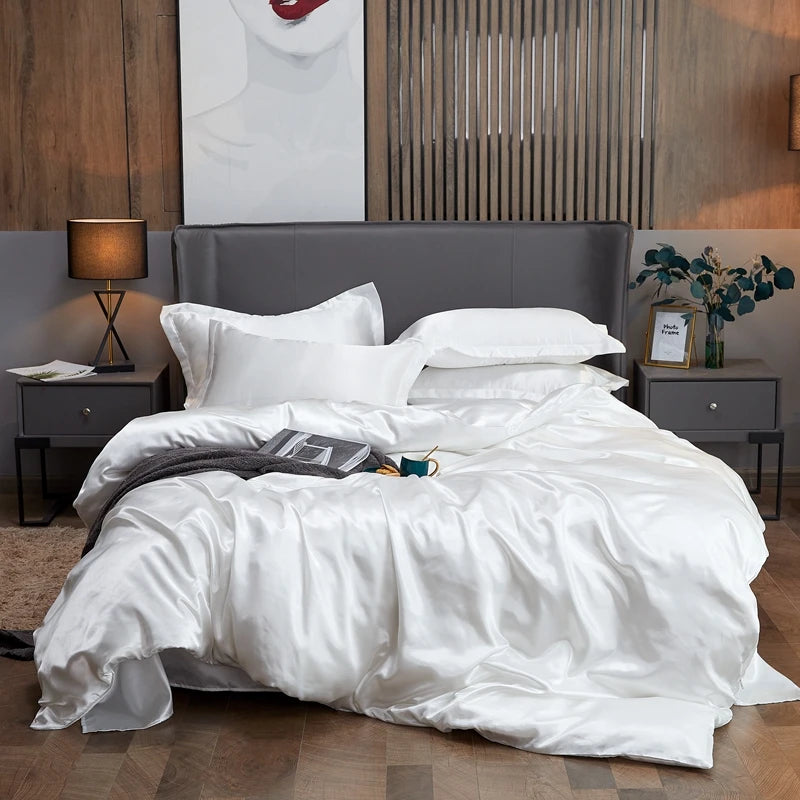

White Bedroom Decor: Add Character with Textiles
Louis MikolajczakWhite Bedroom: How to Add Character with the Right Textiles
A white bedroom can feel bright, clean, and restful. But it can also quickly become impersonal. The white color isn't the problem. It's the lack of nuances, textures, or contrasts around it.
Many people think they absolutely need to repaint to elevate a bedroom that feels too neutral. In reality, bed linen, throws, cushions, curtains, or small touches of texture can be enough to give a room true personality without making it lose its brightness.
The principles discussed in the Orea article on pairing bed linen and wall paint already help to understand how surfaces interact. Here, we're starting with the most common scenario: a white bedroom that needs warming up without major renovations.
Table of Contents
Direct Answer: Focus on Texture Before Color
The first thing to do in a white bedroom is to add dimension. Not necessarily color. White on white can be stunning if there are multiple materials, densities, and finishes. Conversely, a single, smooth white on all surfaces quickly makes the room anonymous.
So, before looking for a strong accent, add differences in texture: a more matte duvet cover, a softer throw, a slightly textured cushion, a pillowcase with a subtle border. Character often comes from visual tactility before it comes from the palette.
- Multiply off-whites rather than a single white.
- Add a visible texture to the bed or end-of-bed bench.
- Introduce a subtle warm tone if the room remains too cold.
- Maintain dominant light to avoid disrupting the room's spaciousness.
The Bed: The First Lever to Add Presence
In a white bedroom, the bed almost always occupies the central visual space. This is where you gain personality the fastest. A bedding set that is too smooth or too white can appear clean but devoid of emotion. By playing with the overhang size, texture, and a slightly warmer shade, the bed immediately takes on more allure.
The recent Orea article on bed linen sizes clearly shows this: a well-proportioned bed looks more high-end even before you consider its color. So, character also begins with how the linen drapes and fills the space.

Tones That Awaken White Without Drowning It Out
To add character to a white bedroom, the best allies are often warm, muted tones: sand, natural linen, light taupe, soft brown, sage green, or smoky blue. They remain compatible with light but avoid a too-clinical effect.
The key is to remain measured. One or two accents are more than enough. If everything becomes too contrasted, the bedroom loses the purity that was its initial appeal.
| White Base | Recommended Accent | Achieved Effect | To Avoid |
|---|---|---|---|
| Cool White | Warm beige or sand | Softer room | Adding additional icy gray |
| Off-White | Taupe or light brown | More depth | Staying in the same tone throughout |
| Bright White | Sage green or smoky blue | Calm character | An overly vivid and isolated accent |
Textile Details That Truly Change Perception
It's not necessarily the large pieces that make all the difference. A subtle border, a slightly contrasting pillowcase, a well-placed throw, or a cushion in a denser material can be enough to give the bedroom intention. As soon as a detail appears chosen, the room ceases to be neutral by default.
One must also consider the lighting. A lamp that is too white or curtains that are too flat can negate all the work of the linen. In a white bedroom, coherence comes from the whole: material, light, nuance, and proportions.

When a Darker Touch Becomes Useful
Some white bedrooms remain too ethereal despite beautiful materials. In such cases, a darker note can serve as an anchor. Not necessarily pure black, but a tobacco brown, a rich taupe, a smoky blue, or a denser wood, used on a textile detail or a small volume, is sometimes enough to stabilize the entire room.
The mistake would be to think that a dark accent must dominate. Its role is simply to provide a focal point for the eye. If it remains a minority and is well placed, it reinforces the bedroom's personality without stealing its light.
Conclusion
A white bedroom doesn't need to be repainted to become more present. Often, it's enough to better style the bed, vary the whites, add one or two warm nuances, and let the materials set the tone.
Character isn't necessarily spectacular. In a bedroom, it's primarily found in appropriateness. And this appropriateness very often comes through home textiles.