
Hotel-style bed: the layers of linen that make all the difference
OreaShare
Hotel-style bed: the layers of linen that make all the difference in stacking order
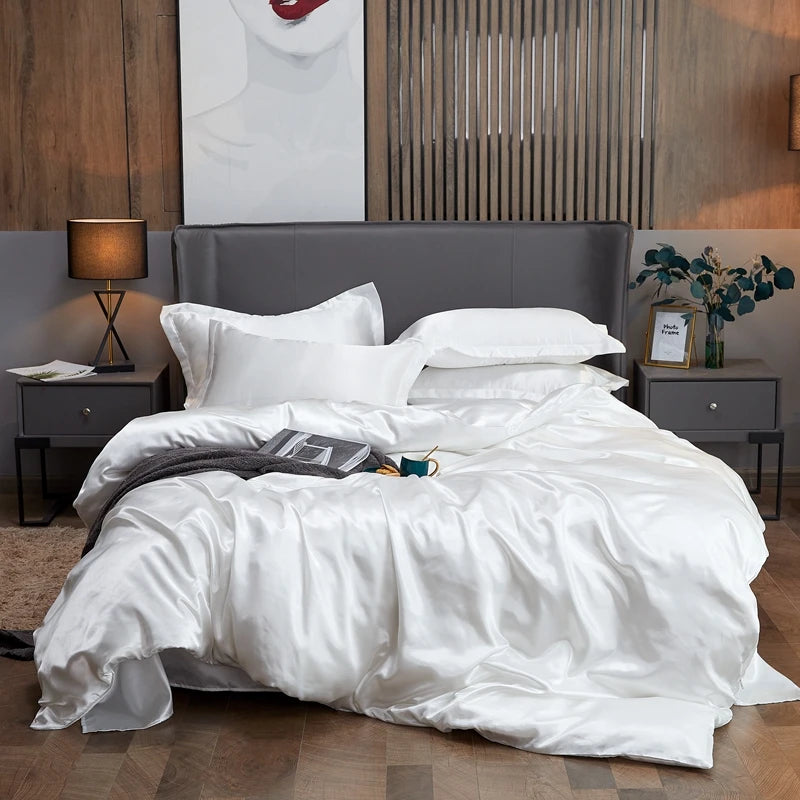
A hotel bed doesn't just feel comfortable because it's white. What really changes the look is how the linen layers are prepared, aligned, and stacked. The mattress looks neater, the duvet seems more generous, and the pillows add volume without turning the bed into a pile.
The good news is that you don't need to multiply textiles. A few well-chosen layers are enough: a clean, taut base, a suitable duvet, then one or two decorative elements that add dimension. To create this base from a coordinated set, you can also browse our bed linen collection.
This guide focuses on the order of the layers and their role. For the finishing touches that then give a more professional look — alignment, volumes, folds, and visible details — consult our guide Hotel-style bed: the details that make it "pro".
Table of Contents
1. Start with a neat base
The "hotel" look begins before the decorative cushions. The fitted sheet must be the right size, taut enough not to form visible pockets, but without straining the seams. A mattress protector that is too thick or poorly fitted can create bumps that will then show through all the linen.
If you use a flat sheet, place it evenly and leave enough length at the foot of the bed to be able to fold it back or tuck it in neatly. It is not mandatory: in many rooms, a well-installed duvet cover is sufficient. The idea is to keep only the layers that have a real purpose.
The size of the linen matters as much as the technique. A duvet that is too narrow will never give a generous effect, even if perfectly tucked in. To check the proportions according to your mattress, also consult Hotel-style bed: the right linen size according to the mattress.
2. Add volume with the duvet
The duvet creates the main mass of the bed. For a more enveloping look, shake it before putting it back in place to distribute the filling. Align the cover with the edges, then check that the four corners of the duvet are well engaged in the cover.
The top edge can reach near the pillows or be slightly folded back to create a horizontal line. This small fold makes the bed look cleaner and allows a sheet or a contrasting side of the cover to show through.
However, avoid artificially seeking enormous volume. A duvet adapted to the season and the mattress will be more pleasant to live with than a stack of two duvets solely for aesthetics.
3. Build the pillow layers
Hotels often use several pillow formats, but you can achieve a balanced result with only two levels. First, place the sleeping pillows against the headboard, then add a pair of more decorative cushions or pillowcases in front of them.
Maintain a logical size order: the largest elements in the back, the smallest in the front. On a double bed, a symmetrical composition is the easiest to reproduce. On a narrower bed, limit the number of cushions to save enough space and avoid having to empty half the bed every night.
Volume also comes from the filling. Reshape the pillows with your hands and distribute the filling in the corners. A pillowcase that is too large for a small pillow immediately gives a soft appearance; a fitted pillowcase looks neater without extra effort.
4. Add a throw or blanket without weighing it down
The throw or blanket is the last layer. Its main purpose is to create an additional line, texture, or color. You can fold it into a horizontal band at the foot of the bed, lay it slightly diagonally, or let it drape more loosely over one side.
If the duvet and pillows already have a lot of texture, choose a simple throw. If the linen is very plain, a textured throw can provide the missing relief. The goal is not to cover the duvet, but to create a visual transition at the foot of the bed.
5. The simple order to reproduce at home
- Mattress protector if necessary, well-fitted.
- Fitted sheet taut and aligned.
- Flat sheet optional, if you actually use it.
- Duvet and cover well distributed over the mattress.
- Sleeping pillows against the headboard.
- Decorative cushions in limited number.
- Throw or blanket at the foot of the bed to complete the composition.
If you want to review the setup of a duvet cover, pillowcases, and different pieces without focusing solely on the hotel effect, our guide how to put on a duvet cover set covers the assembly in a simple order.
Once this base is mastered, you can play with textures and colors without losing clarity. The secret is to keep each layer identifiable: the duvet should remain the main mass, the pillows build volume at the head of the bed, and the throw completes the composition.
Conclusion
To achieve a hotel-style bed, start with functional layers rather than decoration. A taut base, a well-distributed duvet, pillows organized from largest to smallest, and a single throw are already enough to transform the look.
Only then, work on the details: symmetry, folds, colors, and finishes. This separation between structure and finish allows you to achieve a neat bed without creating an accumulation that is difficult to live with on a daily basis.