
Outdoor tablecloth: which material to choose for summer?
Louis MikolajczakOutdoor tablecloth: what material to choose for a carefree summer?
The best material for an outdoor tablecloth in summer depends primarily on your actual use. If you're looking for something easy to live with, quick-drying, and suitable for outdoor meals, polyester is often the most practical choice. If you want a more elegant and natural table for summer lunches or terrace dinners, cotton or linen can be beautiful, provided you accept a little more maintenance. And if your absolute priority is table protection and quick cleaning, a coated tablecloth or waterproof option remains the most reassuring solution. In this article, you will see which material to choose based on your outdoor space, your entertaining style, your tolerance for stains, wind, sun, and repeated washing.
If you are actually furnishing a terrace or balcony, this choice of material should be considered along with the complete table setting. Our guide to setting a practical and elegant outdoor table complements this comparison, while our collection of outdoor tablecloths allows you to compare models designed for this purpose.
- Why material changes everything outdoors
- The quick answer based on your use
- Polyester: the simplest for everyday use
- Cotton: pleasant, but more demanding
- Linen: the most elegant for a beautiful summer table
- Coated tablecloth: practical for zero stress
- Clear comparison of materials
- Which material to choose based on your situation
- Colors, patterns, and visual appearance outdoors
- The most common mistakes
- How to care for an outdoor tablecloth in summer
- Frequently asked questions
Why material changes everything outdoors
A tablecloth used outdoors faces different constraints than an indoor dining room tablecloth. In summer, it often has to contend with several things at once: heat, sun exposure, sweating glasses, consecutive meals, crumbs, sauce stains, wind, sometimes morning dampness, and frequent washing. That's why a simply "pretty" tablecloth isn't enough.
The right fabric must answer a very simple question: how will this tablecloth live in your home? A table set under a pergola doesn't require the same material as a table in direct sunlight. A romantic dinner for two on Sunday doesn't have the same needs as a family lunch with children. A beautiful outdoor tablecloth isn't just a matter of style. It's also a question of durability, ease of use, and ease of maintenance.
Concretely, the material will affect five essential points: the drape of the tablecloth, its stain resistance, its quick-drying ability, its behavior in the sun, and the effort required to keep it beautiful all summer. It is therefore the material that determines whether your outdoor table remains pleasant to live with... or becomes another small chore.
The quick answer based on your use
If you want a clear answer without reading the whole comparison, here it is:
- For daily outdoor use: polyester is often the best compromise.
- For an elegant and natural summer table: linen is very beautiful, especially for a refined ambiance.
- For a warm and classic look: cotton remains pleasant, but it requires more attention.
- For meals with children, frequent aperitifs, or a highly exposed table: the coated tablecloth is the most reassuring.
In reality, there isn't one single best material. There is above all the material best suited to your summer. Some people want a table that's always impeccable in seconds. Others prefer a more lively, textile, authentic look, even if it requires a little more care. This is the point that needs to be embraced from the start.
Polyester: the simplest for everyday use
For most outdoor uses, polyester remains the most practical material. It's not necessarily the most noble on paper, but it's often the one that best meets real-life needs. It holds up well to repeated use, wrinkles little, withstands frequent washing, dries quickly, and generally remains more stable than natural fabric when the air is humid or hot.
On a terrace, balcony, or in a garden, this is a huge advantage. A polyester tablecloth doesn't force you to constantly monitor everything. If a glass spills, if drops fall, if children place their hands on the table, maintenance is simpler. The fabric also often maintains a neat appearance longer throughout the day, which is appreciated when entertaining.
Another advantage: polyester is now available in much prettier finishes than before. It's no longer necessarily cold or shiny. Some models have a matte look, a softer feel, and better imitate natural fabrics. For a tablecloth intended to remain beautiful without too much effort, it is often an excellent choice.
However, a nuance must be kept in mind. If you are looking for a very high-end, very natural, very textured table, polyester can sometimes seem a little smoother, a little less lively than a beautiful linen or a nice washed cotton. But for a simple summer life, it is clearly one of the most effective materials.
Cotton: pleasant, soft, but more demanding
Cotton is appealing because it immediately has a familiar and warm feel. It creates a convivial, soft, welcoming table. It's a material that works very well for summer lunches, holiday tables, floral atmospheres, or more natural décors. A cotton tablecloth often has a pleasant drape and a more authentic presence than a purely synthetic fabric.
However, to be honest: outdoors, cotton requires more vigilance. It absorbs liquids more, stains certain marks more easily, and can wrinkle faster. If it stays outdoors for a long time or undergoes very frequent washing, it can also lose its visual appeal more quickly than a well-designed polyester.
Cotton is therefore very suitable if your outdoor table is rather sheltered and if you like more natural materials. It is also interesting if you change tablecloths often depending on the occasion, for example, for a lunch with friends, a brunch, or a summer dinner. In this case, its charm largely compensates for its slightly more demanding nature.
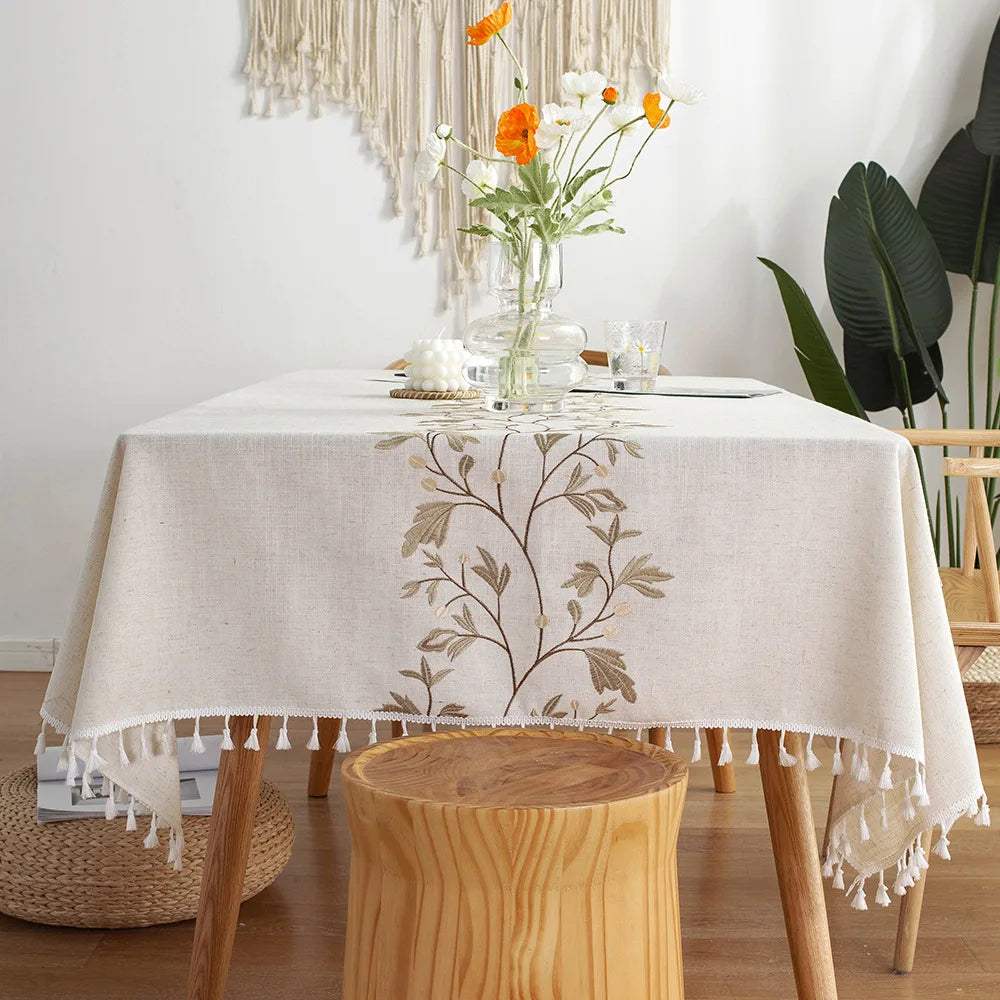
The good compromise can be a fairly thick, well-woven cotton, in a color that better withstands real life than pure white. An ecru, sand, soft terracotta, sage green, or a discreet floral print will often be easier to live with than a too light and uniform shade.
Linen: the most elegant for a beautiful summer table
If your priority is aesthetics, linen deserves your full attention. It has something few other materials can provide: an impression of freshness, naturalness, and effortless elegance. A table set with a linen tablecloth immediately has a more refined, lively, and cared-for appearance. It's the fabric that best evokes long summer meals, bright terraces, holiday homes, and simple yet beautiful tables.
Linen works particularly well in light, muted, or earthy tones. Off-white, beige, string, grayish blue, old rose, soft olive green: these are shades that showcase it beautifully. It also captures light very well, which makes it magnificent outdoors.
But again, you have to choose with full knowledge of the facts. Linen wrinkles. That's even part of its charm. If you want a perfectly smooth table from morning to night, it's not always the best option. It may also require more careful maintenance depending on its quality and finish. It's not the most "carefree" material, but it's often the most beautiful for a chic and natural summer ambiance.
In practice, linen is ideal for a sheltered, decorative, convivial outdoor table, where visual pleasure counts as much as practicality. For a large reception, a weekend lunch, or a formal dinner, it is clearly one of the most beautiful choices.
The coated tablecloth: practical for zero stress
The coated, waxed, or waterproof tablecloth sometimes has a bad reputation because it is associated with something too rigid or not very elegant. However, many current models are much more successful than before. And above all, they perfectly meet certain needs.
If you eat outdoors often, if you have children, if you want to protect your table as much as possible, or if you hate stubborn stains, this is a very relevant solution. A simple wipe is often enough. Water beads more on the surface, sauces penetrate less quickly, and the tablecloth more easily maintains a neat appearance throughout the day.
The trade-off is the look. Even with beautiful finishes, a coated tablecloth doesn't always offer the same supple and natural drape as washed linen or cotton. It is often a bit more structured, sometimes thicker, and its feel is different. That said, on a family table or a heavily used table, this practical aspect often makes all the difference.
For summer, it can be particularly interesting on a wooden table that you want to protect, or on an outdoor area exposed to repeated meals, snacks, aperitifs, and minor everyday accidents.
Clear comparison of materials for an outdoor tablecloth
| Material | Advantages | Limitations | Ideal for |
|---|---|---|---|
| Polyester | Resistant, quick-drying, low wrinkling, easy care | Sometimes less natural look than plant fibers | Daily use, frequent meals, easy outdoor living |
| Cotton | Pleasant feel, warm ambiance, classic look | Absorbs more, stains and wrinkles more easily | Sheltered table, occasional meals, convivial atmosphere |
| Linen | Beautiful drape, natural look, summer elegance | Wrinkles, requires more care | Formal table, summer dinners, refined decoration |
| Coated fabric | Good protection, quick cleaning, reassuring with children | More technical feel, less supple drape | Intensive use, families, very exposed table |
The best choice is not the same for a beautiful reception table and for a table used morning, noon, and night.
Which material to choose based on your situation
For a garden table used daily
Polyester is generally the most logical choice. It requires less maintenance, withstands repeated use better, and maintains a clean appearance more easily. It's the right choice when you want something practical without constantly thinking about it.
For a beautiful summer table on a covered terrace
Linen often provides the most beautiful result. It creates a softer, more elegant, more natural atmosphere. It's ideal for meals you want to make a little more special.
For a family table with children
A coated tablecloth or easy-to-wash polyester will avoid a lot of stress. When meals are frequent and small daily actions matter more than the staging, this is the most comfortable option.
For a balcony or a small decorative outdoor table
Cotton can work very well, especially if you like delicate prints, floral motifs, or soft atmospheres. It immediately adds charm, provided you don't leave it constantly exposed to the outdoors.
Colors, patterns, and visual appearance outdoors
A material is never chosen entirely on its own. Its appearance also changes depending on the color and pattern. Outdoors, very dark shades heat up more in the sun and can sometimes visually show dust or water marks. Conversely, very pure whites are bright, but often get dirtier more easily.
For a summer table, the easiest colors to live with are often natural shades: beige, ecru, sand, linen, soft green, light blue, dusty pink, muted terracotta. They blend well with the outdoors, summer light, wood, stone, or metal.
Patterns can also help. A very light solid fabric will require more meticulousness than a light, floral, or botanical print, which naturally masks small marks better between washes. It's a simple detail, but it greatly changes the comfort of use.
Finally, always consider the wind. A very light and supple material can be magnificent, but less stable on an exposed table. In this case, a slightly denser fabric or a more structured drape will often be more pleasant for daily use.
The most common mistakes when choosing an outdoor tablecloth
The first mistake is to buy a tablecloth simply because it looks beautiful in a photo. A very elegant material can become tedious if it doesn't match the way you live your outdoor life.
The second mistake is underestimating the actual exposure of the table. There's a huge difference in constraints between a covered terrace, a semi-sheltered balcony, and a garden in direct sunlight. A tablecloth that works very well in one case can be much less pleasant in another.
The third mistake is to aim for something too light, too fragile, or too delicate when you already know that meals will be frequent and lively. It's better to have a slightly simpler but suitable material than a magnificent fabric that you end up not daring to use.
How to care for an outdoor tablecloth in summer without complicating your life
The simplest approach is not to leave the tablecloth outside permanently if it's not necessary. Even a resistant material lasts better when shaken, folded neatly, and stored after prolonged use. This also prevents the accumulation of dust, humidity, or sun-related marks.
For washing, everything depends on the material, but a few reflexes are almost always valid: quickly treat a stain, avoid letting it dry completely, prefer gentle washing when the fabric requires it, and do not overload the laundry. A beautiful and durable outdoor tablecloth is not necessarily one that is washed aggressively. It is often a tablecloth that is maintained regularly but simply.
If you use an oilcloth or coated tablecloth and it creases after storage, do not compensate with high heat. Our guide on how to uncrease an oilcloth tablecloth without damaging it explains how to gradually soften the marks.
If you want to maintain a good visual appearance throughout the summer, it's also better to have two tablecloths rather than one. This allows for variety, washing without urgency, and adapting the material according to the moment: one more practical for daily meals, one prettier for entertaining.
Frequently asked questions
What is the best material for an outdoor tablecloth exposed to the sun?
Polyester often remains the simplest for a regularly exposed table. It withstands intensive use better and dries quickly. In any case, it is better to avoid leaving a tablecloth in direct sunlight continuously if you want to preserve its colors for a long time.
Is linen a good idea for outdoors?
Yes, especially for a covered terrace or a rather decorative and neat use. Linen is very beautiful in summer, but it is not always the simplest for intensive daily use.
Is a coated tablecloth necessarily less attractive?
No. Today, some models are much more elegant than before. The look is still different from a natural fabric, but for a family table or a heavily used table, it's a very smart choice.
Which fabric to choose for a table with children?
A coated fabric or easy-care polyester is generally the most reassuring. You save time, reduce stress, and the table remains pleasant to live with.
Should you choose a light or dark tablecloth in summer?
Natural and intermediate shades are often the most balanced. They remain bright without being as demanding as pure white, and they integrate very well into outdoor decor.
In summary, the best material for an outdoor tablecloth in summer is the one that matches your real daily life. Polyester is often the easiest, linen is the most elegant, cotton remains warm, and the coated tablecloth is reassuring when you want a simple table to live with. If you are looking for an option that is both beautiful and suitable for the season, the right choice is not necessarily the trendiest, but the one that will make you want to use your outdoor table without hesitation. To complete your decor, you can discover our selection of Tablecloths designed to create a summer table that is as pleasant to look at as it is to use.