
How to choose the right size for a rectangular tablecloth? The simple calculation
Louis MikolajczakRectangular Tablecloth Size: Calculating from Table Dimensions and Drop
The correct rectangular tablecloth size is simple to calculate: measure the length and width of the tabletop, then add twice the desired drop. This rule prevents most errors, whether for an everyday kitchen table or a large table prepared for guests.
The pitfall is choosing a tablecloth based solely on the number of place settings. Two tables for six people can have very different dimensions, especially with an extension. A well-proportioned tablecloth complements the table's shape, allows guests to move easily, and immediately gives a more polished impression.
Here's how to take the right measurements, decide on an appropriate drop, and interpret common sizes without complicated calculations. If your table is round, our guide on round tablecloth sizes will provide the same logic, adapted to diameter.
If you prefer to start with a dimension chart rather than recalculate every time, our guide what size tablecloth for a rectangular table compiles common sizes and their drops. For a 180 cm tabletop, you can also consult the dedicated guide for tablecloth size for a 180 cm rectangular table.
Table of Contents
The formula to remember
The formula is one line long: tablecloth dimension = table dimension + twice the drop. For a 160 × 90 cm table and a 25 cm drop, you should aim for approximately 210 × 140 cm. The 25 cm is added to the left and right, then to the top and bottom.
Always start by measuring the tabletop, without following the edge of the chairs. Take the maximum length and maximum width. If your table has rounded corners, keep the measurement of the imaginary rectangle that contains them: the tablecloth will naturally fall over the sides.
It's not necessary to aim for a size accurate to the centimeter. Tablecloth sizes are often standardized, and a few centimeters more or less won't change the usage. However, a twenty-centimeter difference can transform an elegant drop into a too-short tablecloth. Between two sizes, generally choose the larger one if it doesn't interfere with seating.
What drop to choose depending on use
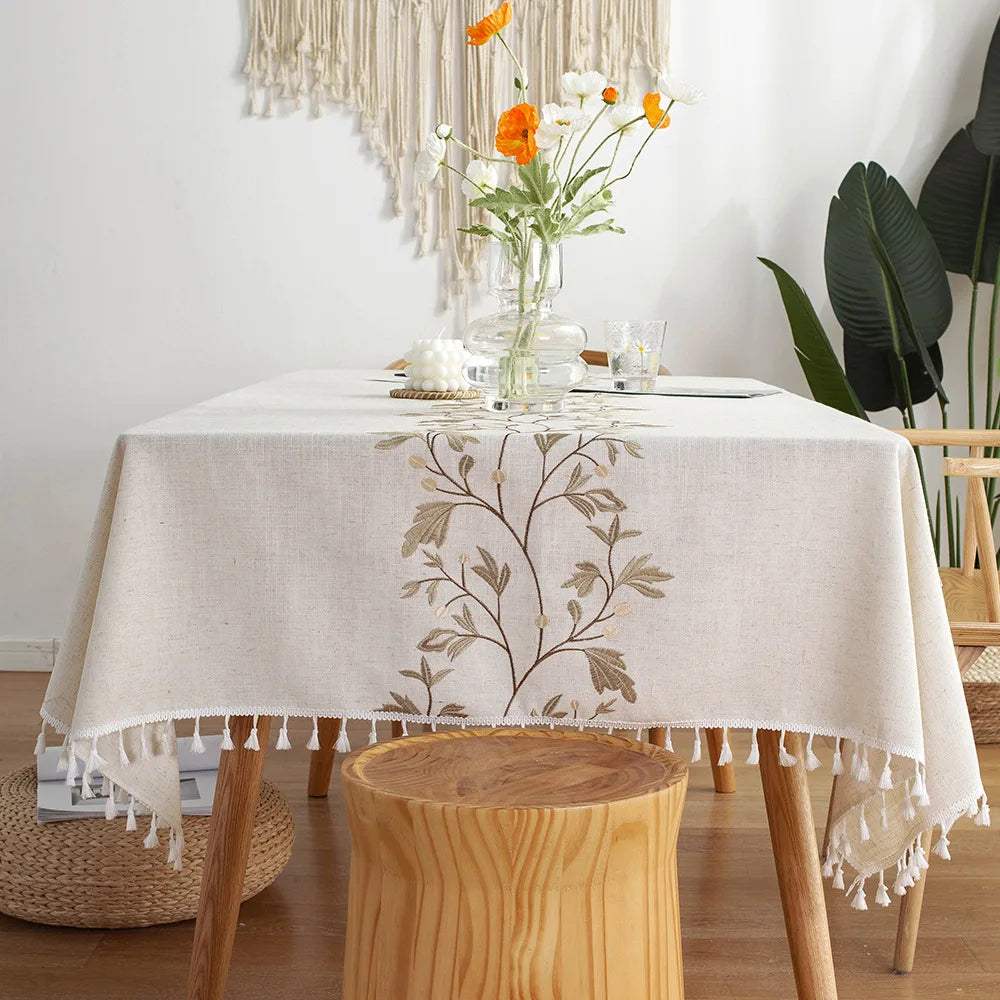
The drop refers to the part of the tablecloth that extends beyond the tabletop. It has an aesthetic as well as practical function. Too short, it gives the impression that the tablecloth is temporarily placed there. Too long, it gets caught under thighs, bothers children, or collects crumbs at knee level.
For everyday use, a 20 to 25 cm drop is a good balance. It dresses the table without weighing down the dining area and allows for easy seating. For a lunch with guests or a more formal table, you can go for 25 to 30 cm. Beyond that, the look becomes more ceremonial and is mainly suitable for occasions where chairs are not constantly moved.
Table height matters. On a coffee table or console, a 25 cm drop doesn't look the same as on a dining table. Look at where the tablecloth will fall in relation to the chair seats. Ideally, it shouldn't get caught between the chair back and legs when sitting down.
| Usage | Recommended drop | Desired effect |
|---|---|---|
| Everyday meals | 20 to 25 cm | Clean, practical, easy to rearrange |
| Lunch or dinner with loved ones | 25 to 30 cm | More dressed up, without bothering guests |
| Holiday or reception table | 30 cm and more | Generous drop, more formal decor |

The tabletop measurement and desired drop directly give the correct tablecloth dimensions.
Calculation examples for common tables
Let's take a small table measuring 120 × 80 cm. With a 20 cm drop, a 160 × 120 cm tablecloth is appropriate. It covers the table well without hanging too low. For a family table of 180 × 90 cm, a 230 × 140 cm tablecloth gives a 25 cm drop, which is very pleasant for daily use.
A large table of 200 × 100 cm often requires a 250 × 150 cm size to maintain a real presence. If you can't find this exact dimension, a slightly longer tablecloth can be more elegant than one that's too short. Just make sure the ends don't obstruct passage.
Choosing a rectangular tablecloth becomes much simpler once you've noted these two measurements and the desired drop. Keep them in your phone: they are also useful for a table runner, placemats, or a protective cover.
To compare several models without starting from a specific product sheet, you can also find our collection of rectangular tablecloths: you'll be able to directly compare the available dimensions with your calculation.
Don't forget extensions and chairs
Extensions account for many failed purchases. A perfect tablecloth on a closed table can become too short as soon as the family grows for the weekend. Therefore, measure the table in both configurations: closed and open. If you often host, it's better to choose a dedicated large tablecloth or keep a second one in a drawer.
The width deserves the same attention as the length. A narrow rectangular tablecloth on a large table can leave the edges too visible and give the impression that the setting lacks generosity. Conversely, a very wide tablecloth on a small table can cover guests' laps. The regularity of the drop matters more than a precise number of centimeters.
Also, try it out with the chairs pulled out. A beautiful tablecloth should not force you to push the chair differently or hold the fabric with one hand when sitting down. Everyday decor should simplify mealtime, not add another gesture.
Does the material change the size to choose?
The formula remains the same, but the drape changes. A soft cotton easily conforms to corners and looks natural with an average drop. A denser polyester can maintain a sharper line and may require slightly less visual length. Linen, on the other hand, lives with its wrinkles; a slightly generous drop often gives it more elegance than a millimeter-tight fit.
Also consider the first wash if the material is likely to shrink. Check the care instructions for the chosen model and avoid planning for a minimal drop when you know the tablecloth will be regularly machine washed. A few centimeters of margin prevent it from suddenly appearing too short after several meals.
Finally, color influences perception. A light tablecloth makes the table more prominent and its drops more visible; a discreet print better masks small variations. Nothing obliges you to have only one tablecloth: a flexible version for everyday use and another, longer one, for entertaining, address two different uses.
Check the result before the first meal
Once the tablecloth is in place, take two minutes to pull out the chairs and sit at each place. The drop should remain even, without catching on knees or getting caught under a foot. This very concrete test confirms that the calculation suits your table and your way of entertaining. It is also useful after the first wash, as some materials may shrink slightly.
| Usage | Recommended drop | Calculation | Point of vigilance |
|---|---|---|---|
| Daily meals | About 20 to 25 cm per side | Length and width of tabletop + two drops | Bothers legs |
| More formal table | About 25 to 30 cm per side | Measure table without extension, then with | Forgetting tabletop thickness |
| Table with extension | Same drop on all four sides | Calculate each configuration separately | Choosing based only on number of place settings |
Conclusion
To choose the right rectangular tablecloth size, measure the tabletop, define the drop that suits your use, and add it twice to each dimension. This simple calculation helps you buy with less guesswork and enjoy your table more. A well-fitting tablecloth doesn't draw attention to itself by being cumbersome: it simply makes you want to sit down and stay awhile.