
Which table runner to choose for Easter?
Louis MikolajczakWhich table runner to choose for Easter? Two beautiful options for a soft, festive, and elegant table
When asking which table runner to choose for Easter, the same hesitation often arises: should you opt for something very decorative, or on the contrary, keep it simple to avoid overwhelming the table? In reality, the prettiest Easter tables are not necessarily the most elaborate. What works best is a bright, fresh, easy-on-the-eye decor, with true coherence between the color of the table linen, the tableware, the flowers, and the overall atmosphere.
For Easter, the right table runner depends less on an "imposed theme" than on the desired effect. If the goal is a gentle, spring-like, and family-friendly table, airy materials, light shades, and delicate details are often the best allies. Conversely, a model that is too dark, visually too thick, or too heavily patterned risks weighing down the table, especially if plates, glasses, some chocolates, a bouquet, or small decorative items are already added.
In this article, the idea is to get straight to the point with real, useful advice. I offer two very relevant choices for Easter, with two different but complementary styles: a soft and slightly romantic model, and a lighter, more openwork, almost timeless model. The goal is not only to show two products but to help you understand when to choose one over the other, how to combine them, and how to avoid the small mistakes that sometimes spoil a beautiful table setting.
To compare more styles, also check out our table runner collection. And if the model is already chosen but you're unsure about the direction, length, or positioning, the guide how to set a table runner complements this selection with very practical tips.
Table of Contents
The direct answer: the two best styles for Easter
If the goal is to choose an Easter table runner that remains elegant, easy to integrate, and pleasant to live with, two options truly stand out: a light textile model in a powdered tone, for a soft and welcoming atmosphere, or a white lace model, for a brighter, more delicate, and more festive table.
The first brings color without being aggressive. It warms the table while maintaining a spring spirit. The second plays more on visual lightness. It allows the wood or tablecloth underneath to breathe, which is very interesting when you want elegant Easter decor without a cluttered effect.
What really works on an Easter table
Easter doesn't need a caricatural decor to be successful. A beautiful seasonal table primarily relies on three things: light, a touch of freshness, and a sense of delicacy. That's why thick, too dark, or too wintery materials rarely work as well as light fabrics, powder pinks, off-whites, light textures, fresh flowers, or openwork details.
In other words, if you're looking for which table runner to choose for Easter, first ask yourself this question: do you want a warmer or more airy table? This is often where the choice is made. A warm atmosphere will lean towards a soft color and a more visible textile. An airy atmosphere will prefer transparency, subtle textures, bright whites, and less dense decoration.
| Desired Style | Recommended Table Runner | Why it works for Easter | Ideal with |
|---|---|---|---|
| Soft and family table | Light textile model in a powdered tone | It warms without darkening and creates a gentle atmosphere | Cream crockery, country bouquets, ivory candles |
| Elegant and bright table | White lace model | It visually lightens the table and brings true finesse | Light wood, transparent glassware, white or pastel flowers |
First choice: a soft and warm table runner
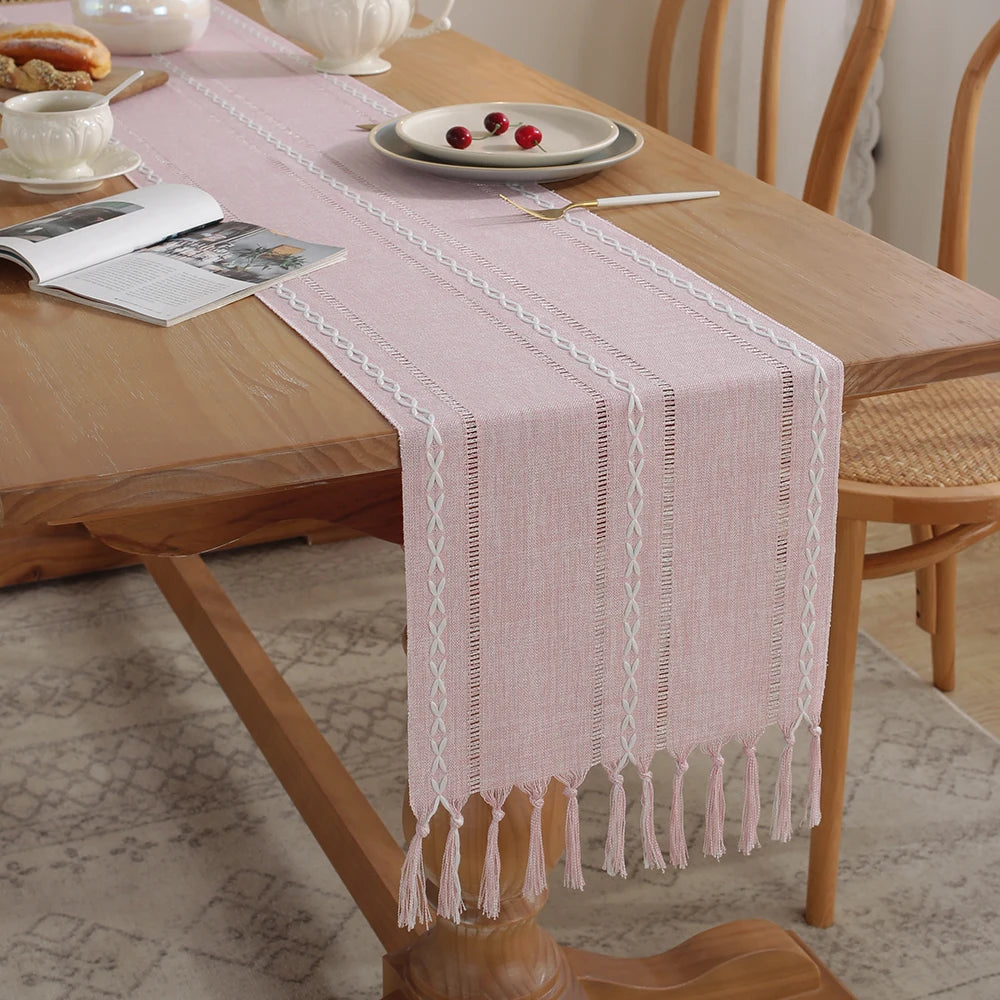
The first model I would choose for Easter is the Communion Table Runner. Even though its name suggests another occasion, it has precisely what is needed for a lovely Easter table: a light shade, a warm textile feel, finishes that add texture, and a decorative presence that remains soft.
What's interesting about this type of table runner is that it doesn't try to do everything. It doesn't replace the decoration; it supports it. It establishes a pleasant visual base, then leaves room for the rest: some light plates, a low vase, fresh flowers, cloth napkins, one or two small gourmet details. The result immediately looks neater, without giving the impression of having tried too hard.
I particularly recommend it in three cases. First, if the table is wooden and you want to maintain a warm feel. Second, if the crockery is mostly cream, white, beige, or gold. Finally, if you want an Easter table that remains soft even with children, chocolates, different plates, or a lively decor. It's a model that absorbs the natural mess of family meals well, because it maintains a calm atmosphere.
Another important point: its light color makes it easy to introduce other seasonal touches. It can be combined with pale yellow, soft green, off-white, very light lilac, or spring flowers. This avoids overly rigid decor. The table remains fresh, welcoming, quite chic, but never cold.
Second choice: a light and refined table runner
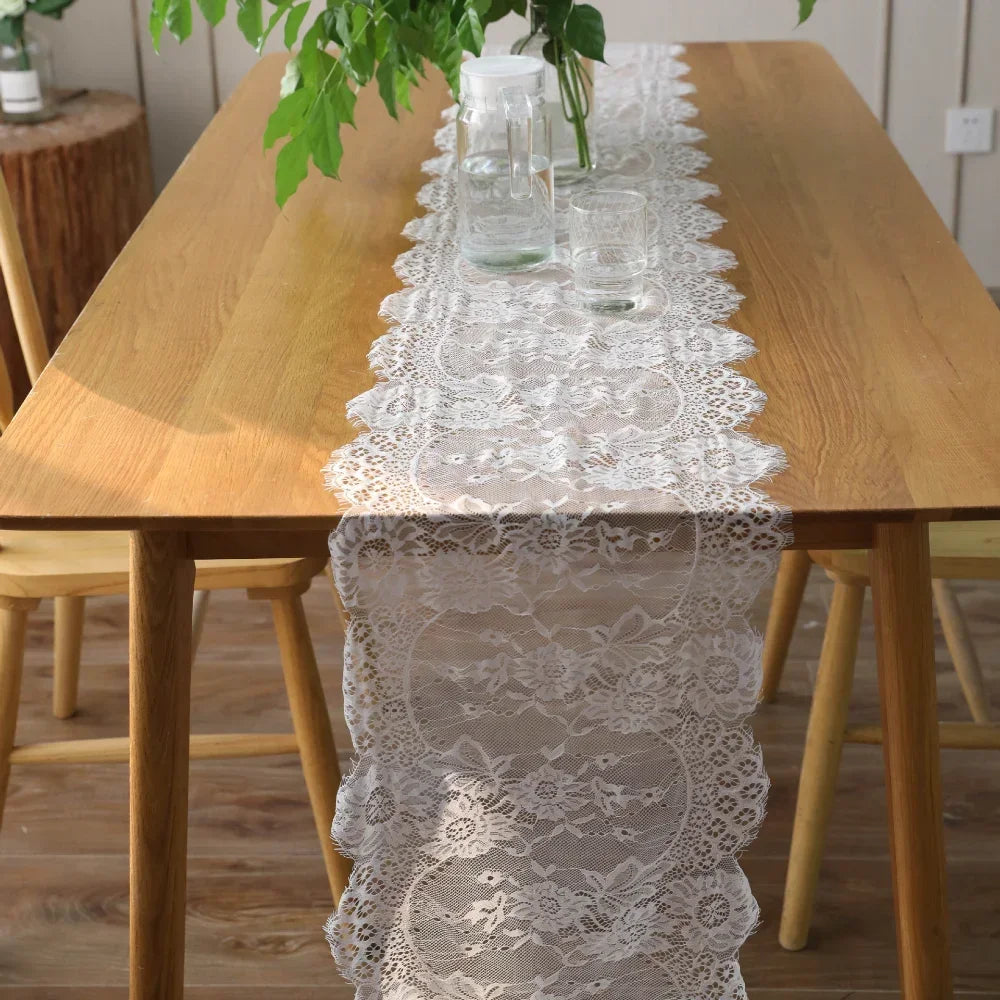
The second model I find particularly successful for Easter is the Lace Table Runner. Here, the ambiance changes. It's less about textile warmth and more about finesse. This is the right choice for those who want a bright, light, more romantic, or visually refined table.
Lace has a very simple advantage: it dresses without blocking the view. As it allows the surface underneath to breathe, it avoids the "block" effect in the center of the table. This is very useful for Easter, because we often add several elements: small floral arrangements, decorative eggs, glasses, cutlery, sharing dishes. With a solid and visually heavy table runner, all of this can become stifling. With lace, the overall effect remains more fluid.
I especially recommend it for light wooden tables, very plain solid tablecloths, or Easter meals where you want a soft but more dressed-up atmosphere. It's also a great solution when the crockery is already somewhat elaborate. Since the table runner remains airy, it doesn't compete with the plates, glasses, or serving details.
There's also a real practical advantage in terms of style: white lace makes it easy to change the atmosphere with almost nothing. With a few white flowers and ivory candles, the table looks very chic. With a little pale pink or soft yellow, it becomes more spring-like. With natural elements like branches, eucalyptus, or small decorative nests, it takes on a very successful elegant country feel.
Which to choose based on your table and ambiance
Between the two, the choice mainly depends on the effect you want to achieve once the table is set. If you want a convivial, gentle, easy-going atmosphere, the light textile model is often the easiest to integrate. It structures the table well, adds softness, and provides a warm setting for the meal.
If you want a finer, visually lighter table, with a touch of refinement without being overly ceremonial, lace is a very good choice. It works particularly well when you want the flowers, glassware, or the material of the tabletop to remain visible.
- Choose the light textile model if you want a soft, family-friendly table, with a clearer decorative presence in the center.
- Choose lace if you want a bright, delicate, more airy, and subtle table.
- Avoid choosing solely out of habit: always consider the table color, the volume of decoration, and the style of the crockery.
How to best pair it with your Easter decor
The table runner isn't everything. For it to truly work, you also need to think about the pairings around it. A beautiful Easter table often relies on a simple principle: one strong element, two soft elements, then the rest in support. If the table runner already catches the eye, there's no need to multiply bright colors. If, on the contrary, it's very light, you can allow for a more visible bouquet or more elaborate glassware.
With the light textile model, I recommend going for cream, pinkish, sand, off-white, or soft green tones. Natural materials work very well: wood, matte ceramic, clear glass, washed cotton napkins. With lace, it's best to maintain a certain sobriety. The most beautiful result often comes from a table that plays on light, transparency, flowers, and empty space.
Mistakes to avoid
When preparing an Easter table, mistakes rarely come from the table runner itself. They mainly come from a lack of balance around it. You want to do well, you add a little bit of everything, and the table ends up looking cluttered.
- Do not overload the centerpiece, especially if the meal is family-oriented and dishes need to be easily passed around.
- Do not oppose too many styles: rustic, romantic, modern, and festive all at once rarely yield a beautiful result.
- Avoid overly harsh contrasts for Easter. An overly dark or aggressive atmosphere often breaks the soft effect desired for this season.
- Do not neglect the fabric's drape: a table runner that is too short or poorly positioned immediately loses its elegance.
The true luxury, on an Easter table, is not accumulation. It's the feeling of harmony. When each element has its place, even a simple decoration looks more beautiful, neater, and more welcoming.
Conclusion
If you're really looking for which table runner to choose for Easter, you first need to think about the atmosphere you want to create. For a soft, family-friendly, and warm table, the Communion Table Runner is a beautiful option. For a finer, brighter, and more delicate table, the Lace Table Runner works wonderfully.
In both cases, the key is to maintain an airy, fresh, and cohesive table. It's better to have two or three well-matched beautiful choices than an accumulation of unrelated ideas. Easter lends itself very well to this type of decoration: simple, bright, generous, and easy to live with. And that's often when tables are most successful.